


Heart Mountain pilgrimage — Remembering the past — celebrating the future
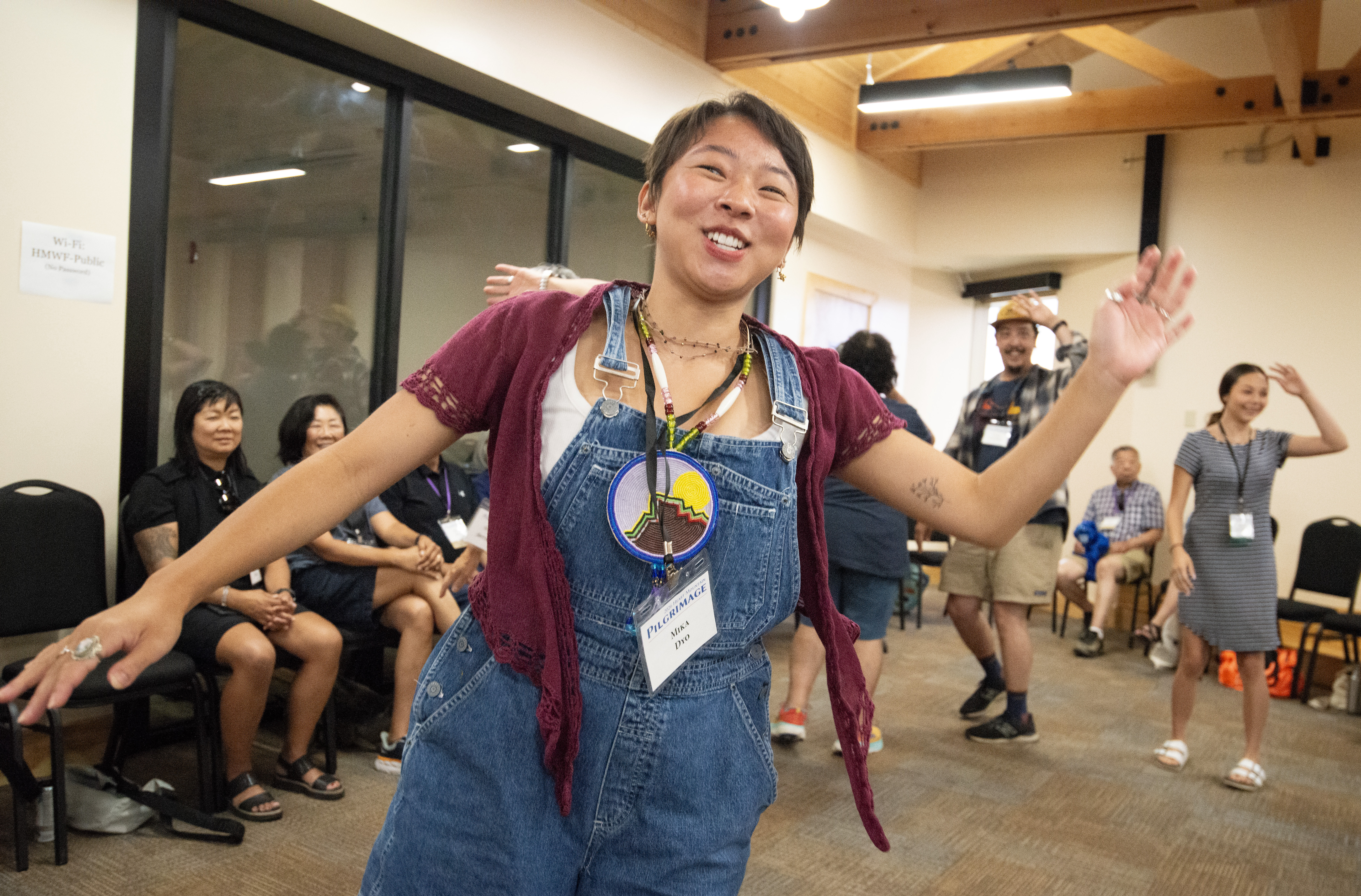
POWELL — Sam Mihara was a 9-year-old boy when his family was swept up from its California home and delivered to what would become the second largest city in Wyoming at the time: the Heart Mountain Internment Camp between Powell and Cody.
It was one of 10 camps in the nation used to imprison Japanese Americans during World War II. Mihara’s father, Tokinobu, had glaucoma when he was rounded up. He was seeing a specialist before being sent to the Wyoming camp, but he wasn’t allowed to do so during his incarceration. He lost his sight while at the camp.
Yet Tokinobu refused to let his disability keep him down. His persistence not to allow his disease or imprisonment to define him led him to translating the Japanese language into braille; he then followed up with 19 more books on the Japanese language, Japanese art and personal accounts.
While at the camp, he created the new system of Japanese braille that could be laid out on a wooden board so that others in his unfortunate situation could learn to read using their fingertips and connect to the world.
“My arms and legs were robbed of their freedom,” he wrote in his autobiography “Guided By My White Cane,” “but the government could not restrict my thoughts and my time.”
Tokinobu’s braille board, created under the stress of confinement, was the first of its kind and is celebrated for its innovation. One can only imagine the torment of not only being imprisoned, but to be blind in a strange, sometimes hostile environment.
Tokinobu also suffered the loss of his father, who died of cancer in the camp hospital. He had been the first of the Mihara family to emigrate to the U.S., wanting to share in the American dream.
More than 80 years later, Tokinobu’s son, Sam, stood last week outside the old hospital at the former camp turned world-class museum — walking in the steps of not only his ancestors, but his own steps as well — speaking to a small group on tour at the facility during the 2026 Pilgrimage.
In the blazing heat, Sam Tokinobu shared his family’s story — something many of those incarcerated in the relocation camps refused to do. For many of those tens of thousands held in internment camps, being detained was embarrassing, and myriad memories were lost as those affected chose to forget the unthinkably difficult situation and rebuild their lives the best they could.
“There is very limited knowledge in the country about what really happened to our people in World War II,” Mihara said during his Thursday presentation.
But Sam isn’t willing to let the horrors of internment camps be forgotten. He has given more than 500 speeches, sharing his story with more than 150,000 people.
“Sam is just an absolute national treasure,” said Vanessa Yuille, whose family was imprisoned in the camp.
In the same way that Mihara refuses to let new generations forget the past, the Heart Mountain Wyoming Foundation, its interpretive center and the MinetaSimpson Institute share the same goal.
It has been a long, daunting experience, said Kathleen Saito Yuille, who was born behind barbed wire in the camp hospital and now sits on the foundation’s board of directors. Yuille said HMWF Vice Chair Douglas Nelson suggested making baby steps to build the world-class museum.
“Doug told us, if we took small baby steps, we could make it into a world-class museum. Fifteen years later, here we are,” Kathy Yuille said. “We [now] have the world-class museum, in addition to, in no particular order, the MinetaSimpson Institute, a historic, iconic hospital chimney, a restored root cellar, a restored barrack, the Setko Saito Higuchi walking trail, the memorial honor roll — soon to be restored — an annual pilgrimage, an engaging website.”
The organization also went from a .net to a .org (Nelson complained about the cost), it publishes a newsletter, called Kokorokara, has created numerous educational and community programs and, within the past two years, has entered into a partnership with Japan through the Japan Outreach Initiative.
“Beyond all that, we are both a national historic landmark and a Smithsonian affiliate, much to be proud of,” Yuille said after receiving the Lifetime Achievement Award. “Not bad for baby steps.”
Lifetime achievement awards
Shirley Ann Higuchi, chair of the HMWF board, said Yuille has contributed significantly to the decades-long effort since before the grand opening for the museum.
“Kathy joined the board during a critical growth period for the foundation,” Shirley Ann Higuchi said. “Prior to the 2011 opening of our Smithsonian-affiliate museum, she contributed significantly to our website and museum content, and ultimately executed a successful grand opening with the support of our volunteers and staff. We were honored to have over 1,000 former incarcerees, families and supporters join us for that historic day.”
The lifetime achievement award is named for Nelson, who first visited the site of the former camp as a graduate student at the University of Wyoming in 1968.
Nelson’s book, “Heart Mountain: The History of an American Concentration Camp,” was the first book to chronicle the sacrifices of the Heart Mountain draft resisters.
Nelson announced during the Saturday awards banquet that the hospital and facilities on the hill overlooking the interpretive center will soon be managed by the Heart Mountain Wyoming Foundation.
“Along with hundreds of babies who were born in that hospital, and in memory of the 165 incarcerees who died in that hospital that sits up on the hill next to the largely restored chimney, the Heart Mountain Foundation is on the cusp of receiving ownership of the 150 acres, including the hospital site, from the Bureau of Land Reclamation. We have made a commitment to preserve and then to restore the hospital buildings, and complete an exhibit that will be a world-class educational experience for telling the story of health and healthcare providers here at Heart Mountain,” he said. “It will not only be an immense resource and view of the life of the incarcerees here, but it also will take this issue of health, healthcare and treatment that occurred at all the other 10 relocation centers.”
LaDonna Zall award
Ted Blair, owner of Blair Hotels, was presented with the LaDonna Zall Compassionate Witness Award for working with the organization to help make the Pilgrimage possible and for his continued support through the years.
“Blair Hotels have been a major part of our success since the 2011 grand opening, and they’ve been with us every step of the way,” said Higuchi.
Helping Heart Mountain has been in the Blair family since it was first built during the war. Blair’s father, Quin, was the pharmacist who served Heart Mountain before becoming a successful entrepreneur, owning several drug stores and hotels.
Higuchi said her mother, Setsuko, was assisted with pharmaceutical services by Blair when she needed her appendix removed.
“If you needed medicine because your appendix was removed, like my mother, or you had serious illnesses — it was Ted’s father that the incarcerees relied on to get their medication,” Higuchi said.
Blair challenged his family to continue supporting the foundation.
“I remember as a child, on drives to Powell, there was this big stone chimney there, and I asked my dad, ‘What is that?’ He said, ‘Son, that’s where the Japanese internment camp was during World War II.’ I said, ‘What was it?’ he said, ‘It wasn’t a good chapter,’” Blair said in a short, but emotional acceptance speech. “My family is here and I challenge them to help and keep going.”
Keynote speech
When Higuchi introduced special guest and keynote speaker Shigeo Yamada, the Japanese Ambassador to the U.S., she admitted to needing to use a dictionary to understand his full title, Ambassador Extraordinary and Plenipotentiary of Japan.
Essentially, the title gives Yamada the power to sign important documents and the authority to act on behalf of his country while in the United States.
The trip to Heart Mountain was Yamada’s first since his term began in 2023.
“To be frank, I have to say that it has taken me far too long to come here,” Yamada said. “Seeing this place in this vast landscape — a place I understand one of the descendants described as a place chosen for its proximity to nowhere — and I understand that now, and also reflecting on, in total, 14,000 incarcerees who spent time here has been a deeply emotional experience for me. While this place bears witness to profound injustice, it also tells an inspiring story of the resilience of Japanese American spirit, even behind the guard towers and barbed wires.”
Yamada took the opportunity to express his gratitude to all of those who work tirelessly to restore the rights and honor of Japanese Americans and to ensure that the “lessons of this place will continue to be remembered.”
“The generations of Japanese Americans who overcame tremendous hardship while making significant contributions to American society have become one of the strongest and most enduring bridges between Japan and the United States,” he said.
Also speaking was actress Tamlyn Tomita, who first gained notoriety starring in “The Karate Kid Part II,” a 1986 American martial arts drama.
She was introduced by Deni Mineta, widow of American politician Norman Mineta.
“In spite of her very busy schedule, she has always answered the call to do whatever was asked of her to support the Asian American community,” Mineta said.
Tomita’s great-grandparents were both incarcerated at Heart Mountain, as well as her grand aunt. Her great-grandmother died while imprisoned at the camp.
Her message was to become a story teller so we will never forget.
“This is what I impart to you. Tell the stories. Practice telling the stories. You can all become world-class stories to your brothers, to your sisters, to your children, to your grandchildren. Practice it,” she pleaded.
The message is getting out, and area youth pledged their time to volunteer for the Pilgrimage and to learn more about the camp history.
Last year young members of the Heart Mountain Figure Skating Club began volunteering to help during the annual event. Christine Castillo founded and coaches the group on the ice, inspired by her grandfather, Shigeru Oba, who built an ice skating rink during the war for prisoners’ recreation and fun while being detained at the camp.
“The center is very important to me because I am a direct descendant of incarcerees here and my grandfather built the skating rinks that you see pictured in the black and white photos of camp life,” Castillo said. “We want to promote everything that the Heart Mountain Interpretive Center is doing to educate people, not only in the area, but all over the country and the world.”
Castillo knows the future of the story of Heart Mountain is in the hands of our youth.
“It’s really through the younger generations that we are going to be able to share this history and carry it forward,” she said.
The figure skaters were joined this year by pugilists from 307 Boxing and Combat Sports.
“This is social exposure for club members, and part of becoming an informed citizen,” said Frannie resident and 307 Boxing coach Kari Kawano.
Kawano also has a connection to the camp. Her great-grandfather Yanasuke Kawano wasn’t sent to the camp because the Kawano family was already here in Powell. But Yanasuke would come to Heart Mountain and help out with farming. He donated seeds and he also put on a farming workshop for some of the incarcerees, Kari said.
“I think these kids are going to learn about Heart Mountain and Japanese culture, but they also get to learn to be part of the community,” said Sybil Kawano, HMWF Pilgrimage volunteer coordinator and the organization’s education and workshop manager.
For more information about the Heart Mountain Interpretive Center, the Mineta-Simpson Institute, to volunteer or to donate: (307) 754-8000 or heartmountain. Org.
This story was published on July 28, 2026.
Ensure These Stories Are Told
Despite the challenges facing independent local journalism, what sustains us — and fills us with deep gratitude — is the loyal support of readers who believe our communities deserve accurate, trusted, and locally rooted news.
It is no exaggeration to say that we are here because of you. Every story we report, every local issue we follow, every public meeting we cover, and every community voice we lift up is made possible by readers who understand the value of an independent newspaper.
Your support does more than fund articles. It helps protect the independence that allows us to report honestly, ask important questions, and keep our community informed without fear or favor.
If you are able, please consider supporting the News Letter Journal by donating to our Unabridged Fund today. Whether your gift helps cover reporting time, printing costs, video, photography, editing, or distribution, every contribution helps keep local journalism strong in Wyoming.
All gifts are deeply appreciated. Your support helps ensure that local stories continue to be told, local decisions continue to be watched, and local voices continue to be heard.
Thank you for standing with independent community journalism.