


Wyoming a ‘human trafficking superhighway’
SHERIDAN — In 2021, Sweetwater Against Trafficking partnered with Uprising, a statewide anti-human trafficking group based in Sheridan, to conduct a live sting operation to target human trafficking buyers. The operation was simple: deputies with the Sweetwater County Sheriff’s Office set up fake accounts posing as prostitutes and let the buyers come to them.
Staff members were met with an “overwhelming” amount of people in just Sweetwater County who wanted to purchase sex, said Lt. Derek Morrell with the Sweetwater County Sheriff’s Office.
“They had been underneath our nose the entire time, but we just didn’t know what to look for,” Morrell said. “We knew (then) we had a bigger issue in our community than what we originally thought.”
During the sting, Morrell said buyers were knocking on the door while deputies were still handcuffing the previous buyer, resulting in an influx of people too great for the staffing on hand. They shut down the operation after arresting four buyers, including former member of the Wyoming senate John Hastert. The four men were charged with soliciting an act of prostitution, a misdemeanor charge resulting in fines up to $750 and up to six months in prison.
Morrell said he’s certain if the operation were to happen again, it would result in many arrests and repeat offenders.
It’s hard to quantify the reach of sex trafficking — a type of criminal activity that is difficult to track and prosecute.
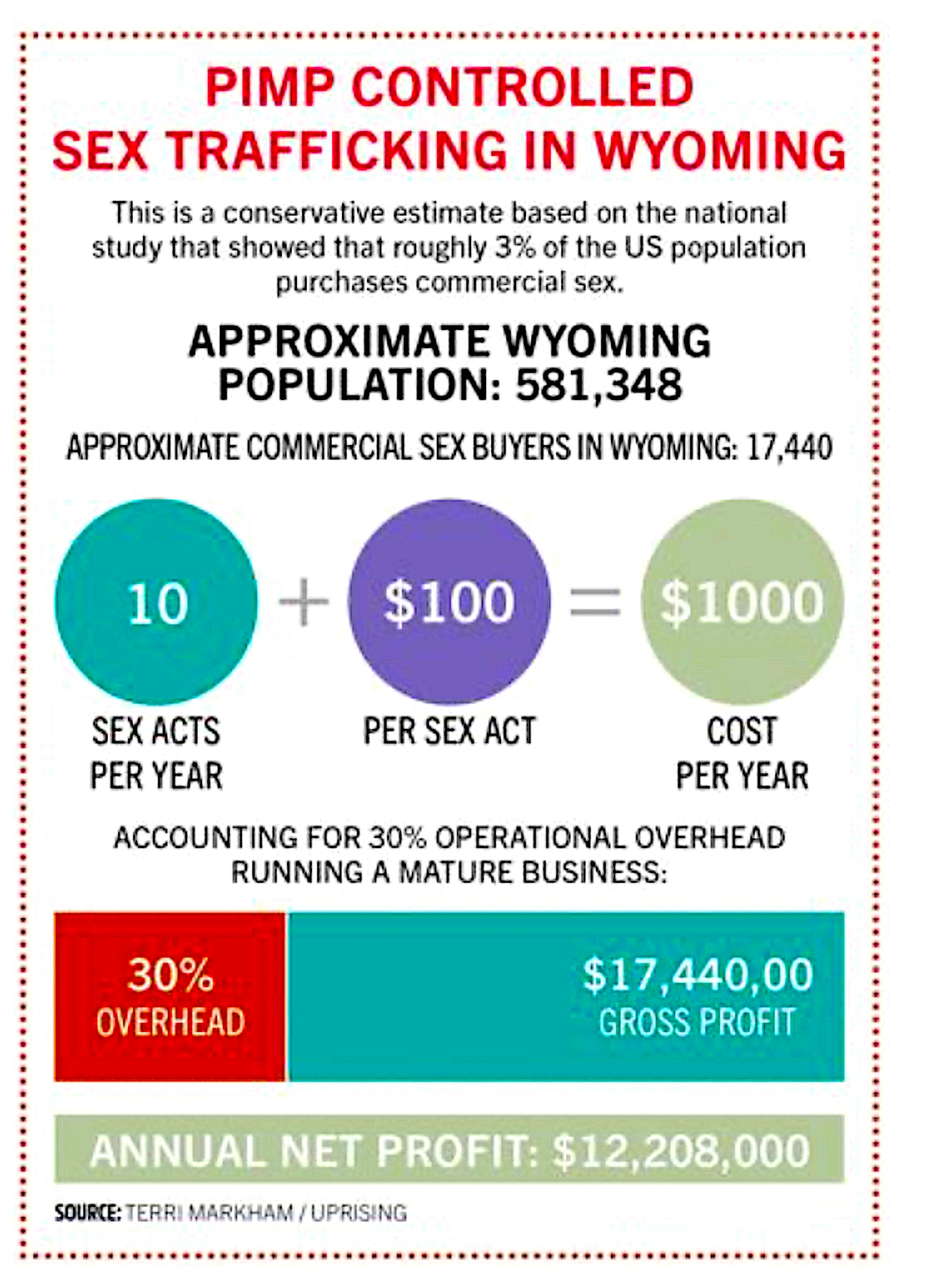
But Uprising Executive Director and Sheridan resident Terri Markham said Wyoming is not immune to its effects and estimated Wyoming likely generates $12 million a year from pimp-controlled sex trafficking alone.
In many ways, Wyoming Division of Victim Services Director Cara Chambers said, Wyoming is susceptible to this type of organized crime. In addition to an established buyer market, Wyoming’s rural population and vast landmass result in many places where traffickers can set up operations undetected. And a large interweb of interstates connects people to some of the biggest hubs in the West.
In an interview with The Sheridan Press, Chambers called this type of system one form of a “human trafficking superhighway” existing within Wyoming’s borders.
‘A circuit’
Three interstates dot Wyoming’s landscape. Interstate 90 from Madison, Wisconsin to Seattle; Interstate 25 from Buffalo, Wyoming to Las Cruces, New Mexico; Interstate 80 from Chicago to the Pacific Ocean.
In the past, victims recovered in past operations have come through the state from the West or East coasts, and Wyoming is only a stopping point.
“There’s a bit of a circuit that these traffickers will take their victims through to Las Vegas and up in California, and it goes through Wyoming,” Chambers said.
Andrew Yedinak, a supervisory agent in charge of human trafficking for the Montana Department of Justice, said I-90 is a common corridor and a “hotbed for commercial sex.” Yedinak looks to both I-90 and Interstate 15 when investigating pimp-controlled trafficking cases in Wyoming’s neighboring state.
Markham said this doesn’t mean all trafficking victims are from out of town or are only passing through a certain area. Some are trafficked through existing networks in their communities. According to the Polaris Project, sex trafficking involves someone using force, fraud or coercion to get someone to sell sex in exploitative conditions. It does not necessarily involve transportation.
All these factors lead to a crime that’s hard to track and charge. Few statistics can quantify its extent in Wyoming. A Federal Human Trafficking Report from 2021 documented zero human trafficking cases and zero convictions in Wyoming, with no convicted defendants or convicted victims.
That isn’t necessarily true.
“It’s happening everywhere. But the problem is, if you go search ‘human trafficking cases in Wyoming,’ you’re going to get very few results,” Morrell said. “There aren’t a lot of cases actually prosecuted under human trafficking.”
Morrell has worked with the Sweetwater County Sheriff’s Office for 15 years, and has been involved in a number of sting operations investigating the extent of human trafficking in Wyoming. But in this time, he’s never once seen a human trafficking conviction.
What he has seen are trafficking cases convicted under other names — like sexual assault or child abuse.
Trafficking charges must show intent, while other charges, like sexual assault, rely on physical action and lack of consent, according to the Wyoming Judicial Branch. Both charges are felonies, but Morrell said one is often easier to prove and requires less burden of proof from the victim.
“Some of it has to do with the protection of the victims,” Morrell said. “We can get almost as much of a punishment out of some of these other crimes as we can the human trafficking side.”
‘11 opportunities’
Combating sex trafficking can happen on different fronts. One is focusing on the victims by equipping them to leave the exploitative situation. Yedinak said removing victims from exploitative environments isn’t always simple.
Law enforcement agencies conducting operations notice a common denominator: those who exploit are preying on the vulnerable.
“When you have a vulnerable population and you have a criminal willing to exploit humans, it’s a terrible combination for exploitation,” Chambers said.
Chambers and Yedinak said traffickers often seek their next victims in places where isolation, poverty and addiction are rampant. They search for individuals without strong financial or familial support, and from there they build a relationship or connection with them.
“These situations encompass a lot of different things. There is physical and emotional abuse, sexual abuse, there’s drug addiction that is often forced upon these victims — because those are all ways their trafficker can maintain control,” Yedinak said. “All the while… their trafficker makes them believe he or she is the only person who cares for them and looks out for them.”
Yedinak said traffickers manipulate their victims into a form of Stockholm Syndrome where they begin to protect their abuser. This, in addition to an imposed fear of law enforcement from their trafficker, creates difficult situations for agents. Yedinak said it takes the average trafficking victim 11 opportunities to leave the life before they do.
“You have these encounters with them, and they’re fearful of what law enforcement may do to them, as far as arresting them and charging them with crime, or that nobody is going to believe them,” Yedinak said. “There have been many cases we have worked where we have dealt with the same victim on numerous occasions, and it wasn’t until that fourth or fifth encounter that we were able to start breaking down those walls and letting them see we truly do care about them.”
In 2019, Yedinak became one of two agents in the state of Montana to focus solely on investigating human trafficking cases. Within the first couple of years, Yedinak said they discovered more than 150 cases of human trafficking. The department has grown to include three agents and a victim advocate. Since 2022, Yedinak said they have recovered 33 adult trafficking victims and 15 juveniles.
Wyoming has several initiatives, including the Human Trafficking Task Force, started by the Wyoming DIV following the passage of Wyoming's human trafficking laws in 2013. But no such team of law enforcement officers exist in the state to solely target sex trafficking.
Ryan Cox, commander of the Wyoming Division of Criminal Investigation said his office does investigate cases involving sex trafficking, but DCI is only granted original jurisdiction over cases involving controlled substances, organized crime, computer crimes, sexual exploitation of children, gubernatorial direction and national/state security.
Cox said DCI does not have direct authority to investigate trafficking or prostitution. If the cases do not involve organized crime or child sexual abuse, they fall under the primary jurisdiction of local police departments and county sheriff offices.
Morrell said investigations and sting operations for local agencies are difficult, especially during a time when many counties in the state struggle with law enforcement officer shortages already.
“It’s just very manpower-consuming… it’s hard, our resources are very limited,” Morrell said. “One of the things that I see (is) the success out of Montana. They do have those resources, and they do continuous operations like that.”
'Cut off the demand'
Another method of targeting sex trafficking targets a different demographic — the buyer, which Markham identifies as the true root of the problem.
“The whole reason trafficking exists is because of the buyer,” Markham said. “They’re the reason a trafficker is victimizing someone to meet that demand. So if you cut off the demand, that’s how you effectively start to end trafficking.”
Morrell said it’s nearly impossible for law enforcement to profile a buyer, further complicating this process.
“The problem with profiling is it literally can be anybody,” Morrell said. “It can be your neighbor who you’ve known your entire life. It could be somebody of influence… first responders, clergymen, all kinds (of people).”
A 2017 survey from the National Center on Sexual Exploitation found that 1 in every 25 adult men — 4 million — had purchased sex in the past three years.
Because buyers are so hard to profile, Morrell said it’s better to ask what factors are drawing people into purchasing sex. He looks at where the buyers could be finding this information, or where they are going to connect with a pimp.
Chambers said Wyoming’s extraction industries are ripe for trafficking endeavors. These operations cling onto the industry’s temporary housing facilities, where workers live in remote and isolated areas for short periods of time. According to 2022 reporting from the Gillette News Record, the state sees the most trafficking cases from Casper, Gillette and Rock Springs. All three of these cities are also located on a major interstate.
The buyers may spur on the trafficking industry, but in Wyoming, charging them for buying sex, technically known as solicitation of prostitution, only leads to a misdemeanor charge. Markham said this is nothing more than a “slap on the hand” that does little to deter repeat offenders. It’s all they could charge buyers with during the 2021 sting in Sweetwater County.
Solicitation of prostitution charges do appear in Sheridan County as well. Since 2007, the Sheridan Police Department cited six males for solicitation of prostitution and one arrest for soliciting minors. The SPD also arrested two people at two different hotels, Best Western and Quality Inn, after investigating a prostitution ad.
The Sheridan County Sheriff’s Office has not investigated any solicitation of prostitution cases in the last 10 years.
But in other states like Montana and Texas, buying sex is a felony leading to several years in prison. Markham thinks this would be a more effective deterrent, especially if this is accompanied with a listing on the sex offender registry.
“(For) everyone to see you were trying to purchase sex, that in itself could be a really effective deterrent in a rural state like Wyoming,” Markham said.
But fighting human trafficking isn’t limited to the legislative floor. Health care staff, law enforcement officers and other frontline workers should be aware of the red flags of human trafficking victims, Chambers said.
In Wyoming, other initiatives include the Human Trafficking Task Force. Chambers said the statewide group was vocal in its support of House Bill 62, an amendment passed in 2025 to add more forms of sexual contact to the definitions of prostitution and solicitation of prostitution. In its twice-a-year-meetings, the task force also organizes trafficking trainings and advocacy events.
'Say something'
Chambers said it was one of the Wyoming Human Trafficking Task Force’s earliest goals to educate law enforcement and then hospital staff. This training involved touring different health care facilities around the state in 2017 with a sex assault nurse examiner — a medical professional with specialized training to care for sexual assault victims.
“Traffickers will not provide a lot of services for their victims, but if they are injured, they will get help, because quite frankly, their merchandise is damaged,” Chambers said.
Chambers said she noticed a similar reaction in nearly every community the task force visited, including Sheridan — a deer-in-headlights look, as health care workers realized they had seen the red flags before.
“It was always, ‘I think I saw it and I missed it,’ whether it was children, young women or men,” Chambers said.
Morrell said law enforcement officers and first responders should be aware of cases that may be deeper than they appear — for example, a domestic violence call or drug arrest may point to a human trafficking situation.
Yedinak said all community members can be involved in stopping sex trafficking. Good physical descriptions, information about nearby landmarks or businesses or even videos, if possible, can be a huge asset in follow-up investigations.
“It’s the old adage of, ‘If you see something, say something,’” Yedinak said. “I would never encourage somebody to put themselves in harm’s way, but if you can be the best witness for law enforcement, document date and time, the location you’re at, any businesses that are around, things that we can look for follow-up evidence.”
Just because communities have few sex trafficking charges or investigations doesn’t mean it’s not happening, Markham said.
“I think the more well trained a community is, the more reports (of sex trafficking) you’re going to have,” Markham said. “The No. 1 thing Sheridan can do is educate yourself.”
This story was published on March 2, 2026.