


WHY DID JESUS ASK PETER THREE TIMES, “DO YOU LOVE ME?”
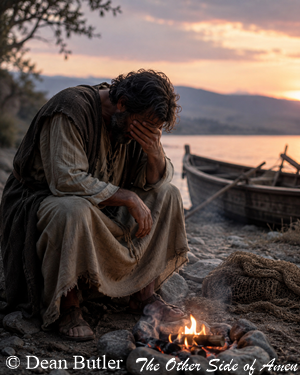
After Peter denied Jesus three times, the risen Christ asked him three times, “Do you love Me?” John 21 shows us something powerful about failure, restoration, love, and following Christ.
Peter had failed badly.
Only a short time earlier, he had confidently told Jesus, “Even if I have to die with You, I will not deny You” (Matthew 26:35).
Before the night was over, Peter denied three times that he even knew Him.
Then the rooster crowed.
Luke tells us that Jesus turned and looked at Peter. Peter remembered what Jesus had told him, went outside, and wept bitterly (Luke 22:61–62).
Peter loved Jesus, but in a moment of fear, he failed Him.
After the resurrection, Peter saw Jesus alive. Yet one important conversation still remained.
John 21 tells us that Jesus met several of the disciples beside the Sea of Galilee. They had been fishing through the night and caught nothing. Jesus called to them from the shore, directed them where to cast the net, and they suddenly caught so many fish they could barely haul them in.
When they reached shore, Jesus already had a charcoal fire burning, with fish and bread prepared.
After they had eaten, Jesus turned to Peter.
“Simon, son of John, do you love Me more than these?” (John 21:15).
Peter answered, “Yes, Lord; You know that I love You.”
Jesus said, “Tend My lambs.”
Then Jesus asked him again.
“Simon, son of John, do you love Me?”
Again Peter answered that he did.
Jesus said, “Shepherd My sheep.”
Then Jesus asked him a third time.
“Simon, son of John, do you love Me?” (John 21:17).
This time Peter was grieved.
Why three times?
John does not directly tell us, “Jesus asked three times because Peter denied Him three times.” So we should be careful not to claim more than Scripture says.
But the connection is difficult to miss.
Three denials.
Three questions.
Peter had publicly denied knowing Jesus, and now Jesus gave him the opportunity to publicly confess his love for Him.
Notice also what Jesus did not do.
He did not humiliate Peter.
He did not say, “I told you so.”
He did not list every detail of Peter’s failure or force him to relive it simply to make him feel worse.
Jesus brought Peter back to the most important question:
“Do you love Me?”
Peter’s failure was real, but it was not the end of Peter’s story.
That matters because Christians sometimes believe that once they have failed God badly enough, they are finished. They may still believe God can forgive other people, but they quietly wonder whether they themselves have gone too far.
Peter is living proof that failure does not have to be final.
But restoration does not mean pretending the failure never happened.
Jesus confronted Peter directly. He brought Peter back to the place where his loyalty had collapsed and made him face the question of his love for Christ.
There is something else important in Peter’s final answer.
“Lord, You know all things; You know that I love You” (John 21:17).
Earlier Peter had been very confident in himself.
“I will never deny You.”
Now there was less boasting.
Peter no longer pointed to his own courage or determination. He appealed to what Jesus knew.
“Lord, You know.”
Failure had humbled him.
Sometimes we learn things about ourselves through failure that success would never have taught us.
Peter discovered that strong feelings and confident promises were not enough. He needed Christ.
Jesus also connected Peter’s love for Him with responsibility.
“Tend My lambs.”
“Shepherd My sheep.”
“Tend My sheep.”
In other words, Jesus did not merely ask Peter to say that he loved Him. He gave Peter something to do.
Care for My people.
Serve them.
Feed them.
Teach them.
Love for Christ is never meant to remain only an emotion.
Jesus had already said:
“If you love Me, you will keep My commandments” (John 14:15).
Our obedience does not earn salvation. We obey because we belong to Christ and love Him.
That is an important distinction.
Peter was not earning his way back into God’s favor by serving. Jesus was restoring a disciple who had failed and sending him back to the work he had been called to do.
Then Jesus told Peter something difficult.
He explained that when Peter became old, he would be taken where he did not want to go. John tells us that Jesus said this to show the kind of death by which Peter would glorify God (John 21:18–19).
Think about that.
The man who had once been afraid to admit that he knew Jesus would someday die because he belonged to Him.
What changed?
Peter finally learned that following Jesus was not about proving how strong Peter was.
It was about trusting Christ.
And after telling Peter about the difficult road ahead, Jesus gave him a simple command:
“Follow Me” (John 21:19).
That was where Peter’s discipleship began, and that was where Jesus brought him back.
Follow Me.
Maybe that is where some of us need to return.
We have made promises and broken them.
We have been confident and then discovered how weak we really are.
We have failed Christ in ways we never imagined we would.
The answer is not to pretend the failure did not happen. Neither is the answer to sit beside it for the rest of our lives believing we are useless to God.
Come back to Christ.
Let Him deal honestly with the failure.
Receive His forgiveness.
Learn the humility that failure should teach.
Then get up and follow Him.
Peter denied Jesus three times.
Jesus did not throw Peter away.
He restored him, gave him responsibility, and called him again:
“Follow Me.”
________________________________________________________________________
“What I write is not for everyone, but what I write is meant for someone.” – Dean Butler
This work may be shared for ministry or personal use, but please credit the author when doing so. © Dean Butler | The Other Side of Amen | All rights reserved.
