


WHERE TWO OR THREE ARE GATHERED: WHAT DID JESUS MEAN?
What did Jesus mean by “two or three are gathered”? Matthew 18:20 concerns church discipline, witnesses, and acting under Christ’s authority.
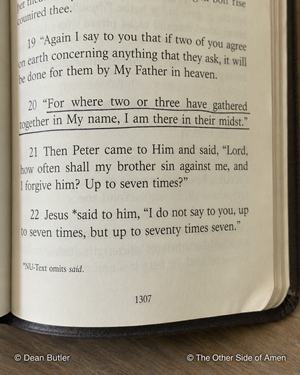
“For where two or three have gathered together in My name, I am there in their midst.” (Matthew 18:20).
This is one of the most familiar verses in the Bible. It is often quoted whenever a small number of Christians meet together. Some use it to assure a small gathering that Jesus is present. Others say that wherever two or three believers gather, they form a church.
I may have said something similar myself at one time. However, when we read the verse in its setting, that is not what Jesus was teaching.
The danger of taking a verse out of context is that we can make the Bible appear to say something it does not say. The words may come directly from Scripture, but the meaning we give them may be wrong. A verse must be understood by reading what comes before it and what follows it.
Matthew 18:20 is part of Jesus’ teaching about confronting a believer who has sinned.
Jesus began:
“If your brother sins, go and show him his fault in private; if he listens to you, you have won your brother.” (Matthew 18:15).
The first step is private. The purpose is not to embarrass the person, spread the matter around, or win an argument. The purpose is to restore a brother.
Jesus then explained what should happen if the person refuses to listen:
“But if he does not listen to you, take one or two more with you, so that on the testimony of two or three witnesses every matter may be confirmed.” (Matthew 18:16).
That is where the “two or three” first appear in the passage. They are witnesses brought into a serious matter involving sin and correction. Jesus was referring to the principle found in Deuteronomy 19:15, which required a matter to be confirmed by two or three witnesses.
If the person still refuses to listen, Jesus gave the next step:
“If he refuses to listen to them, tell it to the church.” (Matthew 18:17).
This shows that the two or three witnesses are not the church. They take the matter to the church. Therefore, Jesus was not using this passage to define a church as any two or three Christians gathered in one place.
Two or three believers can certainly meet for prayer, Bible study, worship, and fellowship. Jesus is present with every believer through the Holy Spirit, even when that believer is alone. But Matthew 18:20 is not a promise that Jesus appears only when a second or third person arrives. Neither is it teaching that two believers automatically become a church when they meet.
A biblical church is more than a few Christians sitting together. It is a body of believers committed to Christ and to one another. It has biblical leadership, teaching, fellowship, prayer, baptism, the Lord’s Supper, service, and accountability.
After explaining how the church should deal with an unrepentant person, Jesus spoke about the authority involved in that decision. He then said:
“For where two or three have gathered together in My name, I am there in their midst.” (Matthew 18:20).
To gather in Jesus’ name means more than mentioning His name at a meeting. It means acting under His authority and according to His instructions. Jesus was assuring those involved that when they carefully and faithfully follow His commands in dealing with sin, He stands with them.
Church discipline is a serious matter. It must never be based on gossip, personal dislike, anger, or the word of one person. There must be witnesses, truth, patience, and a desire for repentance and restoration. Jesus was assuring His followers that He would not abandon them as they carried out this difficult responsibility according to His Word.
Matthew 18:20 is still a comforting verse, but its true meaning is different from the meaning often given to it. Jesus was not establishing the minimum attendance needed for His presence. He was assuring His church of His authority and presence while it faithfully dealt with sin according to His instructions.
This passage also teaches us a larger lesson. We should never build a belief upon one sentence separated from its setting. We must slow down, read the entire passage, and ask what the writer was actually discussing.
A verse taken out of context can be made to support almost anything. Repeating a mistaken meaning for many years does not make it true. Our responsibility is not to defend what we have always heard or even what we may have said ourselves. Our responsibility is to let Scripture correct us.
Matthew 18:20 does not teach that two or three believers make a church. It teaches that Christ stands with His people when they gather under His authority and faithfully follow His Word.
________________________________________________________________________
“What I write is not for everyone, but what I write is meant for someone.” – Dean Butler
This work may be shared for ministry or personal use, but please credit the author when doing so. © Dean Butler | The Other Side of Amen | All rights reserved.
