


Tax money and politics
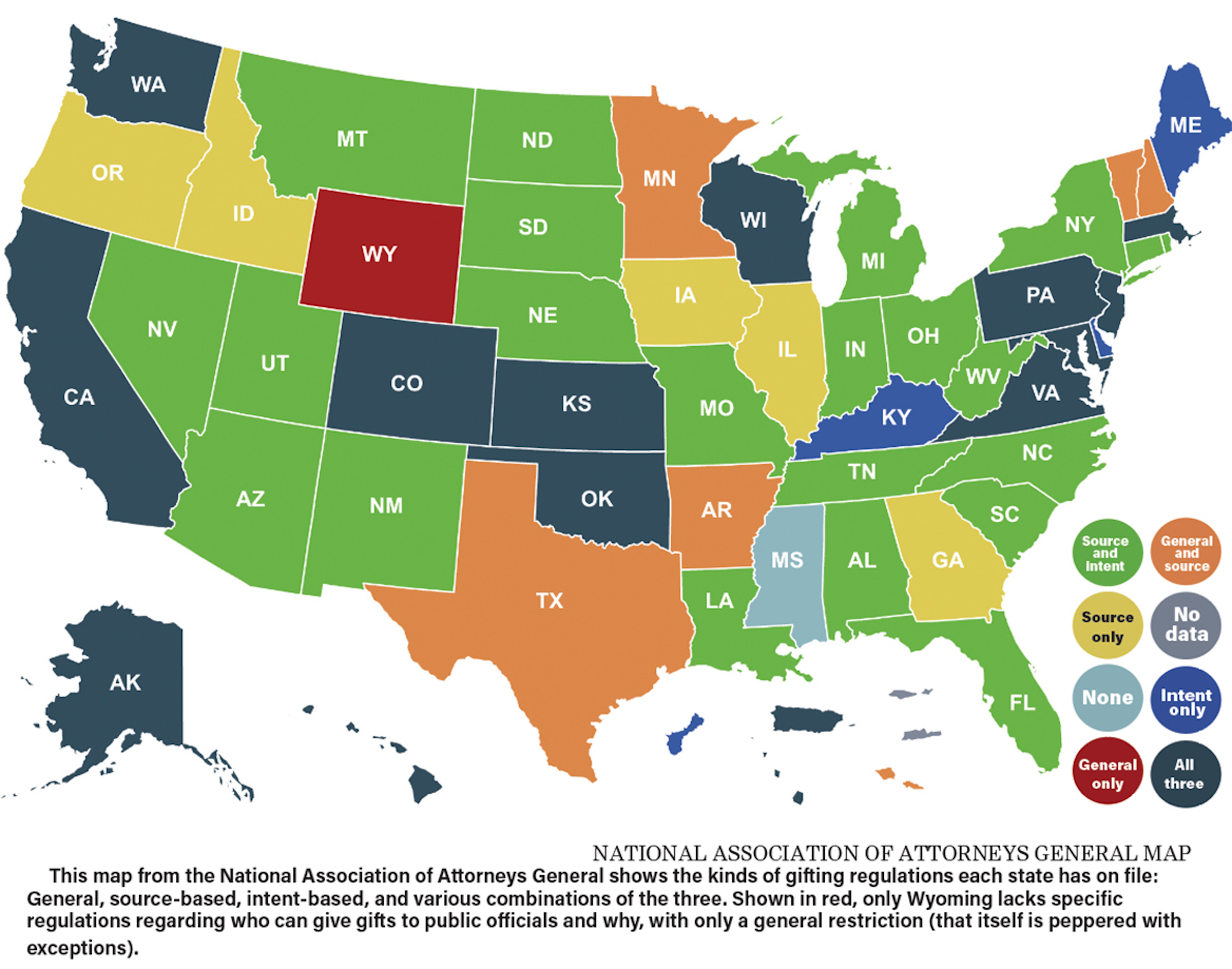
This map from the National Association of Attorneys General shows the kinds of gifting regulations each state has on file: General, source-based, intent-based, and various combinations of the three. Shown in red, only Wyoming lacks specific regulations regarding who can give gifts to public officials and why, with only a general restriction (that itself is peppered with exceptions). Map courtesy of the National Association of Attorneys General.
RIVERTON — During Wyoming's last legislative session, property taxes were top of mind. Some legislators said it was the No. 1 issue they'd heard from residents, and relief was on the way in the form of legislation proposing exemptions for many homeowners.
As lawmakers flocked to Cheyenne, so did lobbyists and local government officials. Across banquet spreads and private dinners with legislators, many government association lobbyists and local elected leaders argued that property tax relief would come at a cost, and municipalities would suffer back home.
At the end of many of those dinners with legislators, county commissioners pulled out government credit cards funded by those same property tax dollars and assured them: "It's on us."
The way that money influences politics in Wyoming can be hard to track. The system doesn't always ask for receipts, but there are many ways that public funds end up as well-oiled gears in the political machine, and lawmakers are taking notice.
And the current system in Wyoming for restricting and tracking political money — and lobbying in general — lacks the teeth experts say are needed for real ethics laws.
Americans for Prosperity says government-on-government lobbying is a trillion-dollar-a-year enterprise.
Here's what that looks like in the Cowboy State.
Follow the money
Lobbying happens in every U.S. state, and every state has rules about what is and is not acceptable – requirements for lobbyists and public officials alike to file reports, limits on what and how much can be given to legislators, rules around what is prohibited and what isn't. Wyoming's laws are, by national standards, relatively lax and generic.
The money in Wyoming politics is a tangled web. Little reporting is required, what is reported isn't monitored, and many elements of the system are seemingly disconnected from each other – so tracking down who spent what money where, and for what purpose, requires navigating a series of dead ends, question marks, and public records request forms across various levels of Wyoming government.
"It's ethics disclosure lite," Sen. Cale Case, R-Lander, summarized.
The state's ethics laws haven't been significantly examined or altered in more than 25 years. And now, legislators are zeroing in on one kind of political spending in the Cowboy State: Taxpayer dollars used to lobby.
Plenty of money is spent on politics in the Equality State, from politicians and political action groups to lobbyists representing industry and other interests.
Governments themselves in Wyoming occasionally dole out public funds for political efforts. And government groups, from cities and towns to the state legislature, also spend public funds to belong to government associations, which in turn lobby up the chain on their behalf.
Government associations are private groups, to which governments and/or elected officials can pay dues in order to become members; these groups also often collect thousands in fees from government entities. Some of the biggest such associations in Wyoming include the Wyoming County Commissioners Association, the Wyoming Association of Municipalities, and the Wyoming School Boards Association.
Several weeks into WyoToday's investigation for this story, a bill was drafted by the legislature's Elections, Corporations and Political Subdivisions Committee, one that would bar tax money from being used for lobbying purposes.
Seemingly aimed at government associations, which receive the lion's share of their budgets from local governments, the bill is a fairly straightforward ban on the practice.
Under recent scrutiny, several of the biggest government associations in Wyoming have said that tax money isn't being used for lobbying – though as 501(c)3s and 4s, their finances are not public — and some legislators remain skeptical of those claims.
The Wyoming School Boards Association brought in $2.2 million in revenue in 2024, with assets valued at $7.58 million. WSBA Executive Director Brian Farmer explained that his organization typically employs two part-time lobbyists and spends around $75,000 annually on those lobbyists; he himself is a registered lobbyist for WSBA. WSBA has not disclosed any lobbyist expenditures in recent years.
The Wyoming County Commissioners Association reported $1.43 million in revenue in 2024, with assets valued at $1.73 million. Its executive director, Jerimiah Rieman, is the organization's main lobbyist, and WCCA currently has a second, month-to-month, contract lobbyist.
WCCA has consistently reported that non-taxpayer dollars have been used in its political spending, including legislative banquets and a campaign in 2022 to get voters behind a Constitutional Amendment.
Rieman said he spends less than 50% of his time on "legislative engagement" and estimated legislative advocacy work costs the association less than $100,000 annually. In part in response to legislative scrutiny, Rieman said the WCCA is working to publish more detailed accounting of its revenue and expenditures.
The Wyoming Association of Municipalities brought in $997,000 in revenue last year, with $2.75 million in assets on the books.
Director Ashley Harpstreith said WAM usually employs one part-time lobbyist, though during the last legislative session it had two. Like Farmer with WSBA, Harpstreith is also a registered lobbyist.
WAM is also among the government associations that throws a banquet for legislators during the legislative session. During last year's session, it spent nearly $8,500 on its legislative banquet, with about $14,500 in total spending on meals with legislators and other officials.
Last year was also the first time that WAM stated on its lobbying expenditure reports that outside sponsorships, rather than tax dollars, had been used for those food and beverage spreads.
When asked for more details on how WAM collected private dollars to fund political activities, Harpstreith declined.
"No – I'm not – no, I'm not giving you my numbers," she said. "And the reason I'm so defensive about that is because I'm not a public entity."
Harpstreith said she'd just crossed the year mark at the helm of WAM; previously, she was a lobbyist for the Wyoming Taxpayers Association.
"So I actually used to be on the opposite side of this, and seeking transparency," she said of her work there.
Though there are many other ways that tax dollars end up finding their way into partisan politics in the Cowboy State, the new bill is focused squarely on government associations.
And when it comes to legislators’ work on the bill, there's a singular question at the heart of the debate: Where is the line when it comes to "educating" legislators and "advocating" for local governments, as opposed to lobbying for a particular team?
Government 'advocacy'
Whether it's government association leaders and lobbyists or local officials, language used to describe legislative outreach has been carefully coded in recent years. Local elected leaders who have used tax dollars on outreach and government association heads have described their work during the legislative session as an effort to educate state officials about how legislation will impact local governments on the ground.
"It's just such a small percentage," said Harpstreith of her budget spent on lobbying. "And then the actual part, if they want to define it as lobbying, where I'm trying to buy a vote, I would say, is probably half of half a percentage point of my time or resources available."
The majority of these associations' work happens well outside the legislative session: Training new local elected officials, providing resources and education to help them follow the law and allowing them to band together to have a voice in Cheyenne.
During a Corporations, Elections and Political Subdivisions Committee meeting this summer in Lander, the packed house was full of elected officials from across the state who showed up to defend the work of their government associations, including both Riverton Mayor Tim Hancock and Lander Mayor Missy White.
They argued – and many county commissioners interviewed for this story echoed – that government associations can work to lift up local voices, that local levels of government are closer to the people. And, it was pointed out, government associations increase efficiency: They prevent exactly the situation that was occurring at that meeting, where every mayor and elected official with a stake in the conversation shows up to testify individually.
"In terms of being able to ensure that our citizens are fairly represented, that they are well represented, WAM plays an extremely important role," Hancock told the committee, pointing to changes to public officer training that took effect a few years ago.
"WAM jumped on that immediately," he said, explaining that WAM offered the training necessary for city council members to follow those new rules. "That's been an incredible benefit to our community."
It isn't just mayors and commissioners who feel that local government is closer to the electorate; some constituents showed up to chime in, as well.
"I am a resident of Sheridan County, and I am speaking as one of those 500,000 taxpayers," Gail Symons commented. "I vote for all five of my county commissioners – but only two of the 93 [state] legislators. I know that [the county commissioners] represent my interests more accurately and directly as a result."
But some disagreed.
"They go and they use our dime, the taxpayer dime, to go and lobby against every one of the bills that the people put forward," Wheatland resident Jill Kaufmann told the committee. "That is unacceptable. We are tired of it."
Americans for Prosperity Wyoming chapter official and former Wyoming legislator Tyler Lindholm said the ways in which tax money is part of the political landscape in Wyoming hasn't been talked about much.
"Most citizens don't know that towns and school boards and legislatures and everybody have full-time lobbyists working for them," he said. During his time in the Wyoming House, "it was an eye-opening experience to see how powerful these [government associations] are."
"It's certainly been this way for a long time," Rep. John Bear, R-Gillette, noted. "But I think that the taxpayers deserve a little better representation."
Big money campaigns
When it comes to government association spending, it isn't just general education about how potential legislation might affect local governments. Several have engaged in true political campaigns for and against government initiatives.
In 2022, when Wyoming had a constitutional amendment on the ballot that would grant permission for local governments to invest tax funds in the stock market, WAM and WCCA spent tens of thousands of dollars to promote it.
WCCA – the association representing county commissioners – disclosed just over $15,000 in spending on the issue. In its spending reports, WCCA specifically stated the money it spent on the campaign didn't come from tax dollars.
WAM, on the other hand, spent $42,000.
As part of WAM's campaign to amend Wyoming's Constitution, it offered 22 social media posts, many with catchy phrases like "Vote Yay for Amendment A" and "Yippe-Ki-Yay for Amendment A" starting in September of that year.
The association, as part of that social media campaign, hid 442 comments on those social media posts. Everyday Wyomingites were barred from the conversation around the government association's campaign.
That same year on the same issue, Wyoming's biggest city got ready to throw down: $7,500 was budgeted for "statewide municipal government marketing campaign for the passage of Constitutional Amendment A."
According to Cheyenne Mayor Patrick Collins, city leaders in Capitol city rethought that spending and ultimately decided against it.
"We chose not to pull the trigger," he said. "We couldn't figure out a way to do that that didn't look like we were crossing a line that we shouldn't cross."
Local governments are regularly on the dime when it comes to spending for political purposes.
Riverton City Administrator Kyle Butterfield boarded a plane to Washington, D.C., on a trip in February for what he called advocating for air service funding from Congress. On Friday when contacted, he was quick to disclose the $2,185.10 cost – which was paid for by city taxpayers. He said it was a fine line between education and advocacy, and that he was about to get on another flight: This time, to Tampa, Fla., for an International City Managers Association conference.
What’s on the plate
This newspaper reviewed hundreds of records from multiple Wyoming counties (including Albany, Carbon, Fremont, Goshen, Teton, and Uinta), and found a striking pattern: County commissioners taking legislators out to dinner on the county dime during the legislative session. Not every county shows the bill on its credit card every year, but broadly across the state, it has become the norm for commissioners to take their respective legislators out for a meal. Some records included itemized receipts – showing orders of everything from mozzarella sticks to seafood dinners to steak – that amount to hundreds of dollars for a single meal.
The practice of taking your local legislators out to dinner during the annual WCCA convention is a tradition that has emerged in order to allow for more local input on state legislation, many of the county commissioners interviewed for this story said.
"Some of the legislation can affect some counties very differently," noted Park County Commissioner Dossie Overfield. "This is an opportunity for us to give them our thoughts … I don't see our role as lobbying; I see our role as educating."
Overfield and some other commissioners explained that there can be a significant disconnect between state legislators down in Cheyenne and the people they are actually representing; the role of county commissioners, the feeling seemed to be, is to bridge that gap.
Additionally, many pointed to the ways in which the same legislation will have vastly different impacts on different counties. The WCCA members vote on its stance on legislation – but some county officials may have differing views or thoughts that they want to convey to their own legislators.
"This is my 15th year [as a commissioner], and I've been involved in that process every single year," commented Platte County Commissioner Steve Shockley. "I've never seen anything I would question … We're all elected officials, and we're all there working for the people in our county."
In recent years, said Sheridan County Commissioner Lonnie Wright, it's been somewhat hit or miss on whether some legislators even show up to banquets and dinners. Wright values the dialogue between different levels of government in Wyoming and the different perspectives and ideas that organizations like WCCA offer.
Fremont County Commissioner Mike Jones said that he used to pay for legislator meals out of pocket – but eventually, those costs started to add up. "I don't like wasting public money either," he explained, but it can be hard to get hold of legislators during the session – and you can have better conversations over dinner than when testifying.
But not everyone feels that these outings are beneficial.
"During the last four years, I just don't feel like [our legislators] listen. I feel like I was beating a drum that wasn't being listened to," remarked Bighorn County Commissioner Bruce Jolley. "If you're going to offer them a free meal, right away that makes it a little lopsided. I don't want that. I don't want them to want it, either … For me personally, we shouldn't have to buy them dinner to get them to listen to us, and it often feels like they don't listen anyway."
"I think it has become an expectation because everyone does it," State Representative Mike Yin (D-Jackson) said of the tradition of taking legislators out to dinner. "Which does not necessarily mean it's the right thing."
How we got here
Wyoming's ethics laws were put on the books in 1998, on the heels of a redistricting effort that led to an influx of new legislators in Cheyenne. There was an appetite at the time for some kind of ethics framework, recalled Case, but even so, it was difficult to get the ethics legislation he cosponsored passed.
Case credits former State Auditor Dave Ferrari with much of the work and momentum behind the bill. It was an incredibly hard fight to get it across the finish line, he said, but Wyoming came out of the 1998 legislative session with a new ethics law for public officials.
The law wasn't perfect, but it was a start.
Some of the limits legislators like Case hoped for, such as restrictions on former elected officials taking jobs in related fields within a year of holding office, were resoundingly rejected. Even so, Case and others who had fought for the legislation hoped that it could serve as a scaffolding for ongoing development and refinement of the state's code of ethics.
In 1999, the one-year-old ethics law was modified.
At that time, Case remembered, some of the exceptions and loopholes that still exist today – such as being able to invite legislators to large events or banquets – were introduced.
Who's watching?
Today, lobbyists must fill out basic disclosure forms to satisfy the state's ethics laws. The forms don't require much in the way of detail, and a WyoToday audit of such disclosures found a peppering of mistakes, from failure to disclose for whom a lobbyist is lobbying, to required funding sources instead listing a series of restaurants patronized by lobbyists.
Some states have independent ethics agencies, established to ensure that public official ethics laws are being followed. In Wyoming, there is no such agency, although the Wyoming Secretary of State's Office collects the reports that are filed and keeps a database of them.
"Lobbyist activity is self-reported and our office does not directly verify the reported content," the Secretary of State's Office explained via email. "The reports are available to the public, so if a member of the public is aware of a discrepancy it can be reported to our office for investigation."
The databases in question can be confusing to navigate, even when a person knows exactly what he’s looking for; this paper's investigation involved hours and hours of trying various search combinations to attempt to paint a complete picture of even just a handful of organizations, and even so there are pieces of the puzzle that are simply missing.
Current limits on lobbyist spending are some of the most general in the country.
There's no limit for food and beverages, which is a lax area of the law frequently taken advantage of in Wyoming. For instance, one dinner purchased by a lobbyist group in 2023 for members of the Joint Transportation Committee came in at more than $19,000.
General limits on loans, gifts, gratuity, discounts and "hospitality" are $250, but disclosure forms do not include enough detailed information about spending to determine when and whether that limit is surpassed by Wyoming lobbyists.
There are also few consequences for breaking the law. Lobbyists may be banned from lobbying for a few years, but breaking these laws does not preclude someone from holding office and the penalties are otherwise relatively minor.
Anh-Linh Kearney, a policy analyst with nonpartisan government accountability organization RepresentUs, outlined the components of good government ethics laws: Transparency, accountability, and enforcement. On all three counts, critics say, Wyoming is far behind most other states.
"When they have so much power, there's a lot of ways they can abuse it," Kearney said. "Real accountability, with teeth, is important."
The bill
The new bill draft in front of the Corporations, Elections, and Political Subdivisions Committee proposes a sweeping ban on the use of taxpayer funds for lobbying.
"The preponderance of the lobbying that we've seen has been counter to what the public, the taxpayers themselves, are looking for," Bear remarked.
In his opinion, it doesn't make sense for taxpayers' funds to be used toward lobbying against measures that are in their own interest, such as property tax relief.
But the bill hasn't gone without criticism. While not familiar with the details of the bill itself, Kearney noted that in order for legislation to be effective it must be specific.
"I appreciate the spirit of [a broad ban], but it really just leaves a mess for lawyers," she commented.
Government association heads, for their part, varied in their responses to the bill.
Rieman, who represents county commissioners, said his organization years ago made a conscious effort to ensure revenue from taxpayers wasn't used for things like political campaigns and lobbying. Farmer, representing school boards, likened the legislation to pushing against free speech.
Harpstreith, the current head of WAM and former Wyoming Taxpayer Association lobbyist, initially said the bill didn't bother her at all. But then, she said, "We (government associations) feel like we're under attack. I just think this is such a witch hunt."
"The intent of the bill isn't necessarily about accountability for taxpayer money, I think the intent of the bill is to silence a level of government that disagrees with who's in power right now," Rep. Mike Yin, D-Jackson, said.
For Case's part, he isn't opposed to associations giving their opinions during the legislative session – but more stringent disclosure requirements may be beneficial.
"I'd rather have their associations be on the same page than deal with [each mayor] individually or create policy in a vacuum," he explained.
Legislators need information to make the best decisions for the state, he continued, and in a small state like Wyoming, they rely on citizens and other levels of government to participate in the process and offer that information.
"It's not necessarily a bad thing on its face – but having it be truthful, having it be open, is important," Case said.
The ultimate accountability on the use of taxpayer funds, Case pointed out, is to the voters at the ballot box. Greater transparency can help inform those decisions.
A spotlight
Wyoming isn't the first state to hone in on the use of taxpayer funds for lobbying efforts.
The Texas legislature has similarly targeted this issue, even convening special sessions in an effort to push a prohibition against taxes in lobbying across the finish line. Alaska recently banned buying food and beverages for lawmakers and added stricter spending limits. And President Donald Trump has compelled Attorney General Pam Bondi to launch an investigation into the use of federal grant money being used for lobbying or partisan politics.
Here on the ground in Wyoming, some leaders said the legislature's focus on government associations is missing the broader picture of needed reform.
"When it comes to campaign financing, there's a lot of improvement that can be made," Yin commented. "In my opinion, the target area [of first step ethics law improvements] does need to be campaign finance."
Case also noted campaign finance as an important area in which Wyoming's regulations are lacking.
Both Yin and Case pointed to the recent case of Honor Wyoming, an organization that carried out vitriolic campaigns against certain legislative candidates without revealing the source of its funding – which was ruled by the Secretary of State's Office to be permitted.
"I think the problem lies in the outside money and influence coming into our state," WAM's Harpstreith said. "That's the story."
This story was published on Oct. 29, 2025.