


Ruptured natural gas pipeline bursts into massive flames; authorities investigate
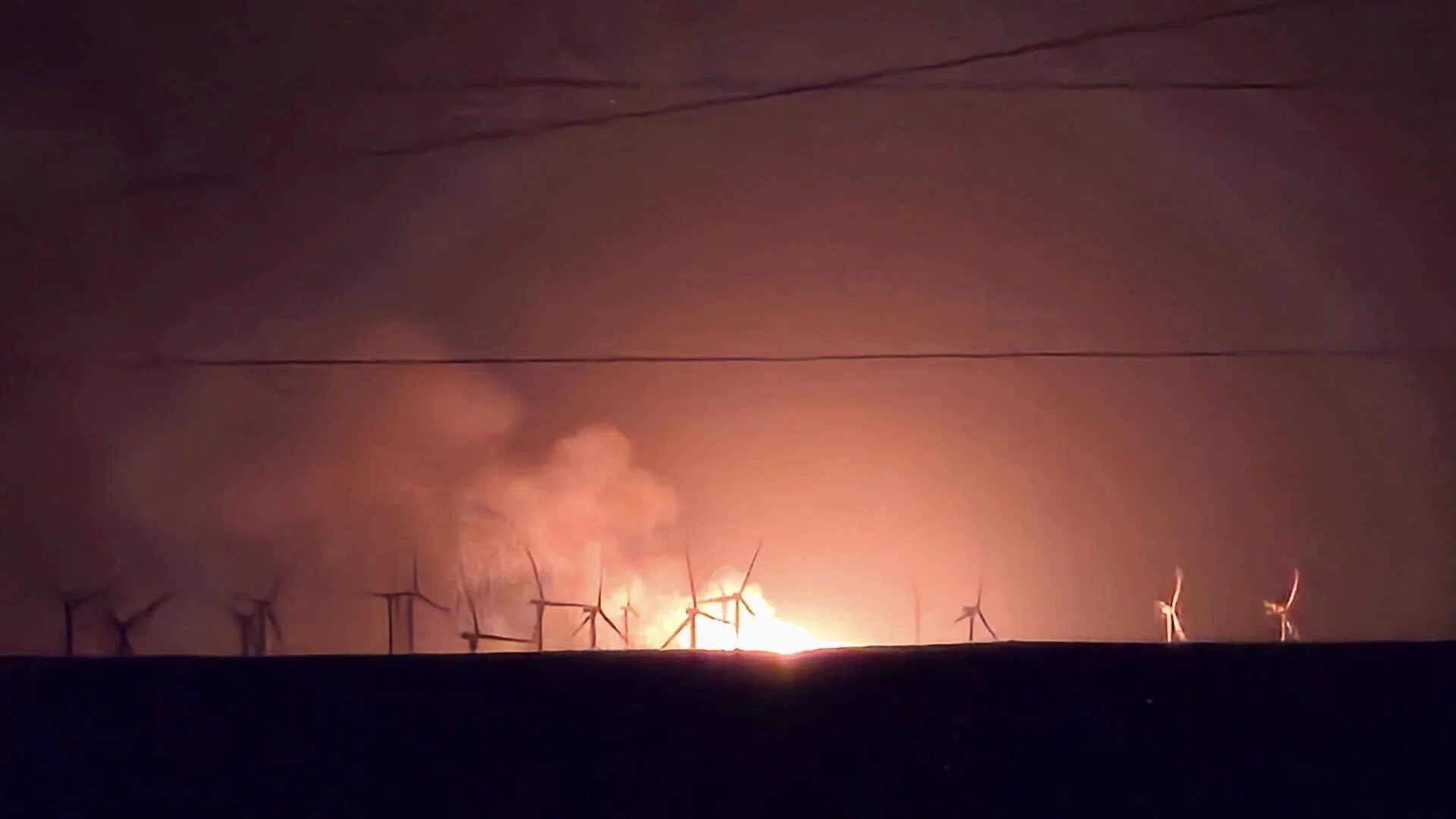
CHEYENNE — After a natural gas pipeline ruptured and sparked a large fire early Sunday morning, the flames charred a freight train and lit up the night sky with a glow that could be seen as far away as Loveland, Colorado.
At approximately 1 a.m., Laramie County Fire District 10 responded to reports of a large fire near mile marker 350 on Interstate 80, west of Cheyenne.
Responding crews were able to confirm that the ruptured pipeline ignited near railcars on a Union Pacific Railroad train which was carrying hazardous materials, placing responders and the surrounding area at heightened risk, according to a news release.
The train was halted around 2 a.m. when it came within about 40 feet (12 meters) of the fire on the ruptured Kinder Morgan pipeline, according to reporting done by the Associated Press.
Because the train’s manifest revealed hazardous materials, Cheyenne Fire Rescue personnel representing Wyoming Regional Response Team #7 were called in a mutual aid capacity.
Using air monitoring equipment and repeated drone flights, CFR and Union Pacific Hazardous Materials personnel were able to assess what was happening near the train cars and determine a safe and practical approach to mitigate the incident.
They determined there was no need to evacuate the area surrounding the fire, which is rural and lacks residential structures, according to Cheyenne Fire Rescue Chief Andrew Dykshorn.
Firefighters had the flames under control as of 9 a.m. At no point did the train derail, and no injuries or fatalities were reported, according to officials.
Additionally, no large hazardous material releases posed a threat to the public, eliminating the need for any evacuation notices, according to Dykshorn.
Aerial photos from the scene showed Union Pacific freight cars still upright, but blackened as crews mopped up the fire around the tracks.
“At no time was there a threat to public safety, and if there was, the appropriate actions and communications would have occurred through several agencies,” Dykshorn said via email Sunday. “We have great partnerships in public safety, and while the public immediately demands information, it often takes time for us to understand the situation thoroughly and ensure a safe approach to mitigate any incidents while coordinating messaging.”
The cause of the incident is currently under investigation by the Union Pacific Railroad and the National Transportation Safety Board.
“This was a significant and dangerous event, and we are grateful for the quick actions of our first responders and partner agencies,” the incident commander, Laramie County Fire Authority Division Chief Caeden Quist said. “Their teamwork ensured the safety of the community and prevented further escalation.”
Hazardous materials
Railcars near the ruptured pipeline were carrying denatured fuel ethanol, a flammable liquid. The liquid has an isolation distance of 150 feet if the liquid is released and a half mile if it is involved in a fire.
“It is unknown if the actual product was released through the pressure relief valves and burned off,” Dykshorn told the Wyoming Tribune Eagle via email Sunday. “The railcar structure does not appear to have failed based on drone footage. Unfortunately, we won’t be able to release the quantities being carried or speculate about that information.”
Another hazardous material listed on the train’s manifest was ammonium nitrate, a more volatile material with an initial isolation distance of 75 to 150 feet, depending on whether it is a solid or liquid.
However, no ammonium nitrate was involved near the fire, and personnel at the site continuously used air monitoring equipment, according to Dykshorn.
In addition to CFR personnel representing Wyoming Regional Response Team #7, the hazmat team, first responders also came from Laramie County Fire Authority, CFR, Laramie County Fire District 1, Laramie County Emergency Management and representatives of Union Pacific and other Laramie County fire districts.
This story was published on Sept. 23, 2025.