


Rare Element Resources tackles public concerns — Crook County residents question mine plans at public meeting
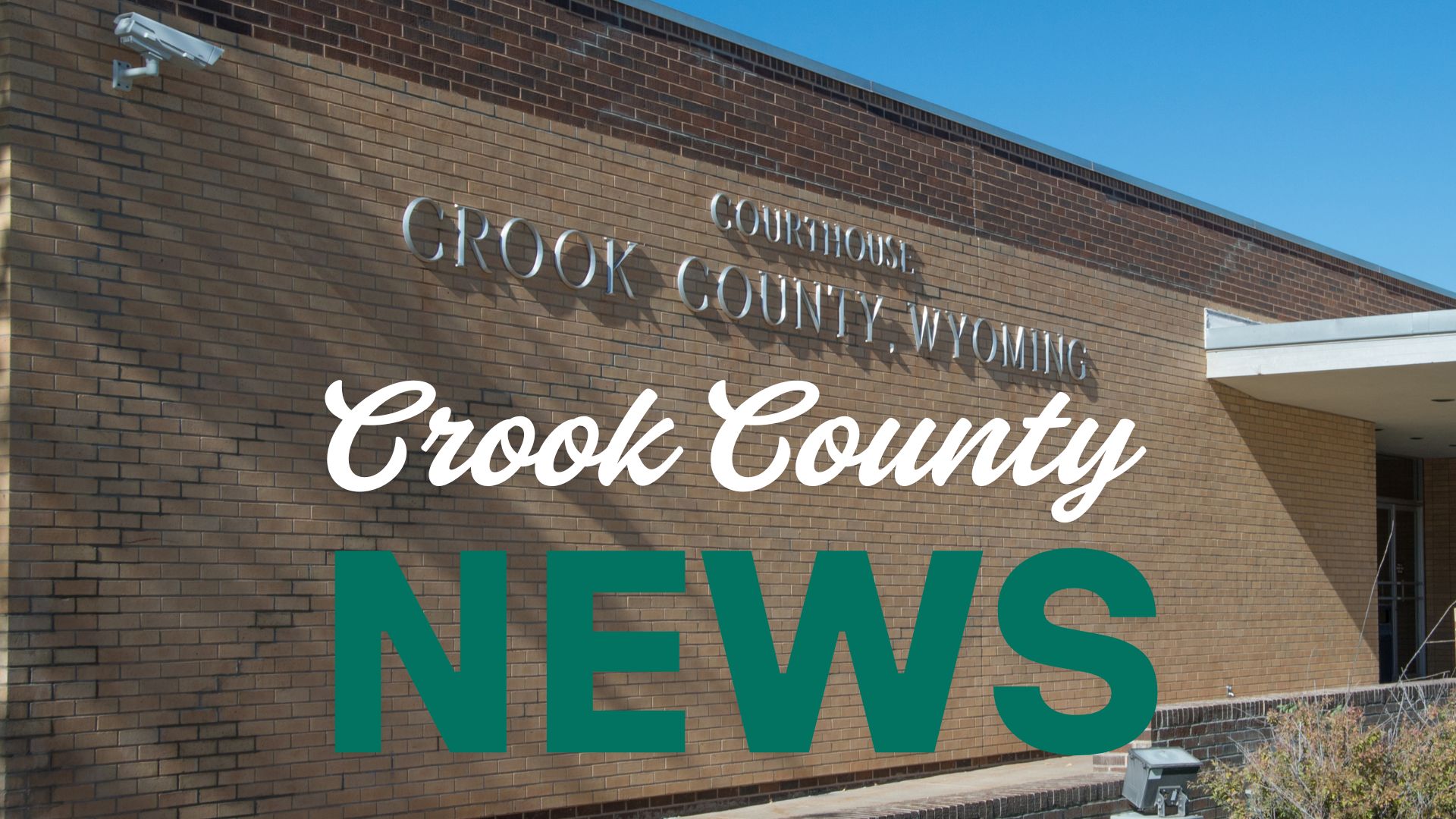
SUNDANCE — At a public meeting on Monday afternoon, Rare Element Resources ad- dressed key community concerns about the company’s plans to construct a mine on Bull Hill in the Bearlodge were addressed.
Notably, representatives shared that the mine will follow strict permitting requirements, there will be no chemical separation at the site and the final access route has not been decided.
The county commissioners’ regular meeting was relocated downstairs to the basement to accommodate the number of citizens interested in hearing the presentation and asking questions as the mine project reaches its first milestone for public comment.
About the Project
Kelli Kast, vice president, general counsel and CAO, and Paul Bonifas, director of business development, led the presentation.
“Thank you for your interest in something that’s very, very important,” began Kast, stating that this mine could place Crook County at the center of something very important to America.
Kast apologized that although RER has been part of the community for 20 years, some feel the company has not been visible over the last couple of months as the permitting process gets back up and running.
RER is here now, she said, and looking forward to the conversation.
The current mine plan would involve a 132-acre plot, with 287 acres of total disturbance; the total project would be 22 years from construction through reclamation, with a target starting date for the mine of 2030.
“We’re blessed with an amazing deposit that is really something special,” Kast said.
This project, said Bonifas, would bring online the second rare earth mine in the United States, the other being in California. The Bearlodge has some of the highest concentrations of rare earths in the world, he claimed – more than 11 times more concentrated than other comparable hard rock deposits.
RER is proposing to do the first three steps in the supply chain: mine to separated oxides; after that comes production of metals, then manufacturing.
The company has invested around $180 million to date in the project, Bonifas said, and estimates it will generate $3 to $5.9 million per year in ad valorem taxes; $3.5 to $10 million in mine-life property tax; and $5 to $11 million in sales and use tax.
A full reclamation plan will be necessary before the mine is authorized, including bonding and financial assurance.
The draft mine plan of operations is a starting point, not a complete plan, representatives said, who said public comments matter and are reviewed and given consideration.
Request for Comments
At this time, Kast said, RER strongly encourages comments on the project because it puts in writing what the community’s thoughts may be and makes sure questions are answered and everyone is comfortable with the process and project.
Three points that she emphasized during the presentation included that there will be no chemical separation at the mine, only mechanical crushing and screening; that the area to be mined is relatively small; and that RER is not considering the use of eminent domain to establish haul routes.
Kast also stressed that RER having been granted FAST-41 status for the permitting process is “not a shortcut” and does not exempt the company from the highest environmental standards, strict regulations and public review and input.
“The concept is holding people accountable,” she said, pointing out that it took nine months to even get an MOU to start the process in 2016, when RER previously attempted the permitting process before running out of funding and going temporarily dormant.
She also expressed hope that it should provide some comfort to the community knowing that the impacts of the project are being properly studied by agencies ranging from the land, air, water quality and industrial siting divisions of the Department of Environmental Quality to the Wyoming State Engineer, Mine Safety and Health Administration, Crook County, Powder River Energy and the U.S. Forest Service.
“Multiple agencies making sure everything comes together, and it comes together for the good of the community,” Kast said.
Road Access
In speaking to a lot of community members on an individual basis, Kast said that many of the same concerns have been raised repeatedly.
The first of these is road access.
Residents of Miller Creek Rd in particular are concerned not only about the amount of traffic that will be using their road, but also the potential for moving the road in the process of upgrading it and the impact on the community.
In the presentation, RER’s representatives said that Miller Creek Rd is not yet confirmed to be the preferred route.
They explained that 11 potential routes were studied back in 2011 and Miller Creek Rd ranked first, with Warren Peak Rd as the principal alternative.
Miller Creek Rd was ultimately recommended for safer grades, winter conditions, footprint and cost. Then, as now, the road was an existing public county road with an established easement and a gravel operation has used it year-round for decades
Those studies were included in the first NEPA process, but no Record of Decision was ever issued.
Today, conditions have changed, according to the presentation, including around 16 more residences along Miller Creek and 56 along Warren Peak. RER is therefore commissioning a new road study to examine every viable option with safety as the highest priority.
The U.S. Forest Service is ultimately the decision maker when it comes to the access route to the National Forest. Kast and Bonifas stressed once again that eminent domain is not an alternative being considered.
“Every proposed access route is along existing easements,” Bonifas said.
In addition, said Bonifas, RER knows that there will be dust and also wear on the road itself.
“RER understands there will be impacts regardless of what route is chosen and we are willing to mitigate that and pay,” he said.
From the audience, Kathleen Fuller shared her math based on six million tons of ore to be taken from the deposit in 35-ton capacity trucks. That’s a minimum of 27 trips per day hauling ore alone, she said.
This would mean a truck passing the road every 15 minutes across a 12-hour day over 17 years. As a county taxpayer, she said, that weight is a huge burden to the road.
Bonifas replied that the 2012 plan included up to $130,000 per year to keep the road maintained, as well as the initial cost of upgrading the chosen road to start with. Pot holes are not good for residents and also “a non-starter” for haul trucks, he said, so a maintained road is a shared goal.
The hours of operation during which trucks would use the chosen route are not yet known.
Water Quality
RER representatives also discussed the potential impacts on water quality and said the company is both aware and actively monitoring. Baseline hydrology work began in 2010 and currently includes continuous surface-level stations and sampling.
Any discharge will be subject to a DEQ permit with strict water quality limits, according to the presentation. Dewatering water may be evaporated, used for dust suppression if it meets standards or discharged under permit.
Stormwater controls will include diversion channels, berms, sediment ponds, check dams, culverts and a prevention plan to protect downstream water quality. Modeling predicts a pit lake below the lowest rim with no overflow and limited access.
Ralph Goodson asked about the potential impact on springs.
Representatives responded that the deposit is in a volcanic intrusion that pushed it away from the Madison Formation, so mining will not occur within that formation.
When Goodson asked about the springs located near the line, he was told that neither the Beaver Creek nor the Whiteclaw Creek spring will be impacted due to shallow aquifers. A couple of springs to the south within the five-foot drawdown may be impacted, but they will be monitored.
Bonifas reiterated that the mine will be “heavily regulated” so, if RER is wrong about this, its mining permit will be revoked.
In terms of water being used at the mine, RER representatives said that number is being worked on but there will not be huge consumption at the mine. If the water run-off does not meet standards, it can be treated to the appropriate standards.
Some commenters still felt uneasy about the potential impact on water and, should something happen, the knock-on impact on residents’ lives and livelihoods.
Page Lambert said she feels that RER has put “the cart before the horse” and should have held this meeting before the Notice of Intent was finished to allow time for research, conversation and thought before commenting.
She described a leak that occurred in 2002 at Mountain Pass Mine, the only other rare earth mine in the United States, which leaked a million gallons of hazardous material. Supervision and
oversight is great, she said, but things happen.
She asked RER to consider paying for baseline well testing for residents.
Radioactivity
Addressing concerns about radioactivity, Bonifas explained that this would concern naturally occurring radioactive material.
“We’re blessed with a very low level compared to other potential resources out there,” Kast added.
Radioactivity is measured in parts per million, Bonifas said, and the rock up there is about 900 PPM. Radioactivity ties itself with rare earths, but this product will be taken to Upton for processing.
“It is a very small number. To the topic of whether or not it is dangerous: it is background. It is the same thing that happens in your back yard,” he said.
You don’t want radioactive waste water or run-off, he acknowledged.
“Not only are we mitigating that, but additionally it is very low levels,” he said, stating that any radioactive material removed in Upton will be shipped off to a waste facility.
Bonifas reiterated that FAST-41 does not lower standards or eliminate review.
The public comment period for this initial phase of the permitting process is open until August 28. Further comment periods will open as the process continues.
RER representatives repeated several times that every comment is worthwhile. A single mention of an issue will have an impact, said Kast, no matter what it concerns.
This story was published on August 6, 2026.
Ensure These Stories Are Told
Despite the challenges facing independent local journalism, what sustains us — and fills us with deep gratitude — is the loyal support of readers who believe our communities deserve accurate, trusted, and locally rooted news.
It is no exaggeration to say that we are here because of you. Every story we report, every local issue we follow, every public meeting we cover, and every community voice we lift up is made possible by readers who understand the value of an independent newspaper.
Your support does more than fund articles. It helps protect the independence that allows us to report honestly, ask important questions, and keep our community informed without fear or favor.
If you are able, please consider supporting the News Letter Journal by donating to our Unabridged Fund today. Whether your gift helps cover reporting time, printing costs, video, photography, editing, or distribution, every contribution helps keep local journalism strong in Wyoming.
All gifts are deeply appreciated. Your support helps ensure that local stories continue to be told, local decisions continue to be watched, and local voices continue to be heard.
Thank you for standing with independent community journalism.