


Nuclear waste town hall gave elected officials a chance to make their stance clear
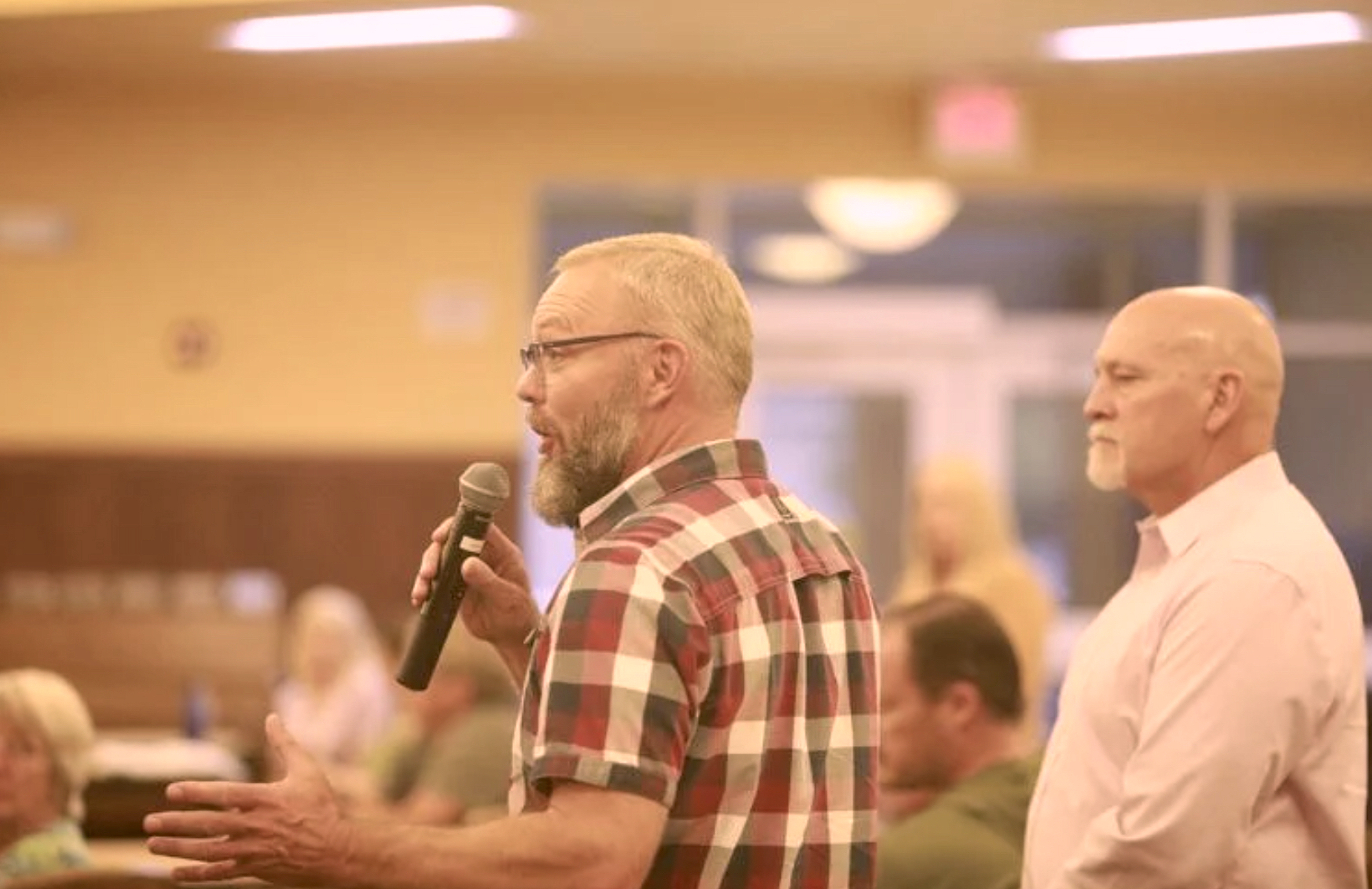
Rep. John Bear, right, looks on as Campbell County Commissioner Jim Ford speaks Thursday evening during a nuclear waste town hall at the Campbell County Senior Center. Photo by Jonathan Gallardo, Gillette News Record.
GILLETTE — Dozens of residents showed up at the Campbell County Senior Center Thursday evening to learn about nuclear waste.
The event, titled “Proposed nuclear waste disposal in Campbell County,” was hosted by Rep. John Bear, R-Gillette, and City Councilman Jack Clary.
John Kotek and Rod McCullum with the Nuclear Energy Institute appeared via video to present on the nuclear industry. They both said that while the nuclear technology of today is very different from what people were used to decades ago, it still results in nuclear waste, and it has to be stored somewhere.
Kotek said the Department of Energy plans to seek expressions of interest at the end of this year to see if any communities are willing to host an interim storage or disposal facility. It would be paid for by the DOE.
Bill Tallen, who worked for 20 years in the U.S. Department of Energy, spoke on the importance of having caution and skepticism when it comes to the nuclear industry.
He said that if done well, the next generation of nuclear energy “is vital to our energy future.” He criticized Radiant, which has caused quite a stir in Wyoming after choosing Bar Nunn as a potential location to temporarily store its nuclear waste.
In Bar Nunn, Radiant would store the spent nuclear waste in sealed containers at the proposed manufacturing site. After manufacturing, the units would be transported to customers across the country and returned to Bar Nunn for storage or refueling after their anticipated 20-year lifespan.
Tallen expressed more confidence in another company, BWXT, which is looking to deploy microreactors in Wyoming.
Compared to Radiant, “BWXT is the adult in the room,” he said.
“What I do see, thus far, is they seem to be more transparent, more upfront in discussing their plans than what I’ve seen (from other companies),” Tallen said of BWXT. “I do not see insurmountable hazards in their plan.”
Questions still remain, however, with BWXT’s future plans, Tallen said.
“Do they plan to refuel their microreactors at that facility? If that happens, where does that go?” Tallen asked.
Tallen said that as far as a federal repository for permanent nuclear waste storage goes, there is not one selected, in the works or even on the horizon, Tallen said.
“There is nothing that Radiant or any commercial operator can do to speed up that process,” he said. “(That means) temporary storage is effectively permanent.”
Bear allowed elected officials three minutes each to state their stance on nuclear energy and ask questions.
Commissioner Scott Clem asked if there were any proposals to store nuclear waste in Gillette or Wyoming, noting that as of right now, state law does not allow for nuclear waste to be stored in Wyoming. Both Kotek and McCullum said there are not any proposals to store nuclear waste in Campbell County.
“Any proposals to bring nuclear waste to Wyoming would have to be through a collaborative process,” McCullum said. “There would not ever be a proposal that would take anyone by surprise to bring nuclear waste into any state.”
Rep. Abby Angelos, R-Gillette, said she’s not against nuclear energy but she is against nuclear waste storage.
“Our job is to protect the welfare of future generations,” she said.
Commissioner Jim Ford said he’s intrigued by the prospects of nuclear energy, saying it has “a part to play” alongside coal, oil and gas. But he was not a proponent of storing nuclear waste in Campbell County.
“I’m not interested in borrowing someone else’s troubles,” Ford said.
He noted that nuclear energy is “probably the most highly regulated and safest energy there is,” but that “when things go wrong, they go very wrong.”
Rep. Chris Knapp, R-Gillette, encouraged the members of the audience to do their own research.
“I’m not an expert, but I can read and I can absorb,” he said.
Commission Chair Kelley McCreery said what he wants is for the nuclear companies to be upfront.
“These companies that are coming in, I would expect them to be completely transparent, I would expect our elected officials to be completely transparent, where we get the truth,” McCreery said. “If we get the truth, you don’t need to tell anybody to be for or against it; it’ll sell itself.”
Sen. Troy McKeown, R-Gillette, asked if nuclear energy is just another “green plan.”
“At the end of the day, why aren’t we developing more coal and gas?” he asked.
Rep. Bill Allemand, who represents Bar Nunn, echoed McKeown’s sentiment.
“We’ve got enough coal for 500 years here in this county,” he said. “We have enough oil and natural gas to run our electricity for many years. Let’s slow this process down, let’s make it safe. Then let’s go for it.”
Ford agreed that things should move slowly on this, but that people should go into it with an open mind, at the very least.
“I don’t think anyone needs to feel rushed to make decisions,” he said. “We should be open to learn and listen to consider what exactly it is that might impact our community and our state.”
This story was published on Sept. 15, 2025.