


Millions for Buildings, but Nothing for Bibles?
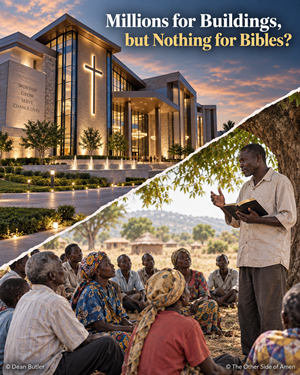
Many churches spend millions on buildings while fellow believers share only a few Bibles. What do our priorities reveal about our hearts?
Please read this carefully. I am not asking anyone to feel sorry for these believers. I am asking us to consider what our priorities reveal about us.
I have shared with my Facebook family and on my website the story of some of our brothers and sisters in Christ who gather beneath a tree to worship, pray, and study God’s Word. They do not have a church building. They do not have padded chairs, large screens, mood lighting, a fog machine, expensive sound systems, or air-conditioning. They have only a few Bibles to share among them, yet they gather because they are hungry to know the truth of Scripture.
Meanwhile, many churches in America meet in buildings worth millions of dollars. We spend money replacing carpet that is still usable, improving sound systems that already work, decorating stages, adding screens, and making ourselves more comfortable. None of those things is automatically sinful. A church building can be useful, and there is nothing wrong with taking proper care of it. But when believers have several Bibles in their homes while fellow Christians must share the few they have, something ought to trouble us.
The apostle John did not leave much room for excuses:
“But whoever has worldly goods and sees his brother or sister in need, and closes his heart against him, how does the love of God remain in him? Little children, let’s not love with word or with tongue, but in deed and truth” (1 John 3:17–18).
It is easy to say that we love fellow believers around the world. It is easy to pray, “Lord, provide for them,” and then spend more on something we want than it would cost to place Bibles into their hands. John tells us that Christian love must move beyond words. When we see a need and have the ability to help, our response says something about what is happening in our hearts.
James gives the same warning:
“If a brother or sister is without clothing and in need of daily food, and one of you says to them, ‘Go in peace, be warmed and be filled,’ yet you do not give them what is necessary for their body, what use is that?” (James 2:15–16).
We could ask the same question about believers who want to study Scripture but lack enough Bibles. If we tell them, “May God bless your fellowship and help you grow,” while doing nothing within our ability to help, what use are our words? Prayer matters, but prayer should not become a way of asking God to do what He may be calling us to help do.
Jesus said, “For where your treasure is, there your heart will be also” (Matthew 6:21). Our budgets often reveal our priorities more honestly than our words do. We may say that reaching people, teaching Scripture, and helping fellow believers matter to us. But where does the money go? How much is spent making those who already attend church more comfortable, and how much is used to place God’s Word into the hands of those who hunger for it?
Paul wrote to Christians who had more and asked them to help believers who had less:
“For this is not for the relief of others and for your hardship, but by way of equality—at this present time your abundance will serve as assistance for their need, so that their abundance also may serve as assistance for your need, so that there may be equality” (2 Corinthians 8:13–14).
Paul was not asking believers to become poor so that someone else could live comfortably. He was asking those with abundance to help meet a real need. Most of us could help without suffering any hardship at all. A church could provide Bibles and printed lessons for an entire fellowship for less than it may spend on one ordinary improvement to its building.
I have shared the story of believers meeting beneath a tree with only a few Bibles among them. Their desire to learn God’s Word has deeply touched me. Yet no one has contacted me to ask, “How can I help them?” That silence has also taught me something. We are often moved by a picture or a story, but being moved is not the same as being willing to act.
This is not about feeling sorry for people in another country. These believers are not helpless. They are our brothers and sisters in Christ. They are gathering, learning, praying, and sharing what they have. The question is not whether we should pity them. The question is whether we recognize them as part of the same body to which we belong.
Paul wrote, “And if one part of the body suffers, all the parts suffer with it; if a part is honored, all the parts rejoice with it” (1 Corinthians 12:26).
Perhaps the church beneath the tree does not need what we have nearly as much as we need what they have. They remind us that the church is not a building. They remind us that a Bible is a treasure, worship is a privilege, and fellowship is worth gathering for even when there are no walls, chairs, or sound systems.
Still, admiration is not enough. If we have the means to help place God’s Word into the hands of believers who need it, we should not close our hearts and walk away. God has given much to many of us. Jesus said, “From everyone who has been given much, much will be demanded” (Luke 12:48).
Millions for buildings while believers share a few Bibles ought to make us stop and examine our priorities. The question is not whether we can afford to help. For many of us, the honest question is whether we care enough to do it.
________________________________________________________________________
“What I write is not for everyone, but what I write is meant for someone.” – Dean Butler
This work may be shared for ministry or personal use, but please credit the author when doing so. © Dean Butler | The Other Side of Amen | All rights reserved. Please reach out at: hopeinchrist2024@yahoo.com https://theothersideofamen.com/our-mission-field
