A legacy of service — Newcastle firefighter honored for 41-year career

News Letter Journal - Staff Photo - Create Article
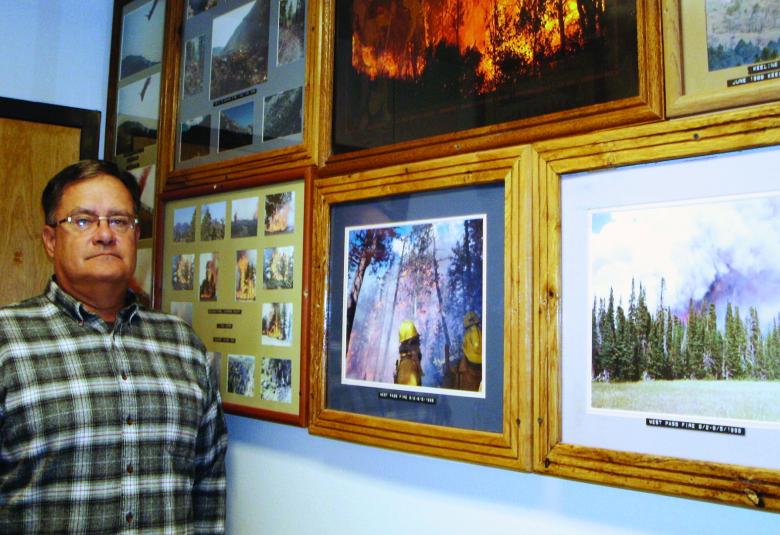
NLJ file photo In this photo from 2011, Rob Akers poses with memorabilia from his career with the Wyoming Forest Service.
By
Summer Bonnar — NLJ Reporter

Rob Akers spent more than four decades building a program that gave Wyoming another resource when wildfires threatened communities and forests.

Now, years after beginning the work that would become the Wyoming Smokebusters, Akers is being recognized for the lasting impact of that work.

Akers, a longtime Wyoming State Forestry Division employee and Newcastle resident, is being inducted into the Wyoming Firefighters Hall of Fame. He was nominated by the Wyoming State Forestry Division and the Weston County Fire Protection District.

For Akers, the recognition is both unexpected and grounding.

“First of all, it was unbelievable,” Akers said. “Second of all, it was very humbling.”

He said the people already represented in the Wyoming Firefighters Hall of Fame include firefighters he worked alongside and looked up to during his career.

“When you look at the list of people who are already in the hall of fame for Wyoming, you feel lucky to be there,” he said. “These people were my mentors.”

Among those he remembers are firefighters from around the state, including Gene Diedtrich of Newcastle.

“I fought fires with all these guys before, and those were guys I looked up to,” Akers said.

Despite the recognition, Akers said he never set out to make his career extraordinary.

“All I ever did was do my job,” he said. “I didn’t think I went overboard.”

From Newcastle to forestry

Akers’ career with the state began with a federal program in Newcastle.

He was first hired as a supervisor for the Young Adult Conservation Corps in 1979. The program lasted one year, but it led to an opportunity with Wyoming State Forestry in 1980, when the state began developing its conservation program.

“We need to have somebody to con the cons, and they figured Akers was the one to do it,” Akers said.

He did not take the comment as an insult.

“I didn’t take it as a slam, I took it as they believed I could do it,” he said.

In May 1980, Akers was hired by the Wyoming State Forestry Division to oversee inmates from the Wyoming State Penitentiary in Rawlins as they performed forest management work on state trust land south of Elk Mountain near Saratoga.

The crews cut timber on state land at the northern end of the Snowy Range Mountains. The inmates would arrive Monday, stay through the week and return on weekends.

Along with the forestry work, Akers began teaching the inmates how to fight wildland fires.

“We taught them how to fight fires, and eventually I would go to the prison and teach them there as well,” he said.

The idea was not unique to Wyoming. Other Western states, including California, Nevada, Utah and Montana, already had inmate fire-fighting programs.

“There are other states that have inmate programs, and have for years,” Akers said. “What we did was take information from those people and start our own program.”

That program eventually became known as the Wyoming Smokebusters.

Building a fire-fighting crew

When the Wyoming Department of Corrections opened the minimum-security Wyoming Honor Conservation Camp north of Newcastle in March 1990, Akers became the program manager of the Forestry Conservation Program.

The program grew substantially. At its peak, it included as many as nine correctional forestry crew supervisors and 55 inmate crew members. The crews worked on community service projects, state trust land management and wildland fire suppression.

The work was demanding, and Akers said the expectations for the inmates were no different from those for other firefighters.

“First of all, they needed to pass the physical fitness requirements,” he said. “Then, there was a 40-hour course.”

Akers said maintaining consistent expectations was one of the keys to making the program work.

“Fair, firm and consistent,” he said, describing his approach to earning the trust and respect of the men he supervised.

Nathan Butler, who worked his way up through being a supervisor, eventually became its program manager, said Akers’ straightforward leadership style made an impression.

“It would be his personality, his way of shooting from the hip,” Butler said. “Telling the truth, being honest.”

Butler said Akers did not hide his opinions, even when they were difficult for people to hear.

“Whether it was what people wanted to hear or not,” Butler said. “Rob was politically blunt. You knew where you stood with Mr. Akers.”

Butler said managing the program required more than simply understanding fire fighting. The crews also involved a security component because they were made up of inmates.

“It takes a certain skill set of individuals to manage inmate squads,” Butler said.

He said Akers was able to motivate both the inmates and the forestry employees who worked under him.

“He was able to instill a sense of pride in the program, and a sense of pride in what we do on a daily basis,” Butler said. “As a manager, I guess he was ‘the glue.’”

For Akers, that sense of pride was one of the most rewarding aspects of the program.

“I think they developed a sense of pride and a sense that they were worth something,” he said. “They would work their hardest to outwork any of the other men on that line.”

More than fighting fire

Over his career, Akers estimates that more than 2,000 inmates worked in the program. Some remained for only a month or two, while others stayed for three or four years.

Akers said one of the most meaningful results was seeing some of those men use the skills they learned after leaving prison.

“We had several inmates that went on after getting released from prison and would go on to work with the Forest Service,” he said. “Periodically, you would hear that these guys would go down that path and use the skills we taught them to be successful.”

Butler said the program also provided a benefit to the state beyond the individuals who participated.

“It is a beneficial, low cost, fire-fighting asset to the state,” Butler said. “You can’t put a number on it with regards to how much it costs, but you can put a number on how much it saved the state of Wyoming.”

The crews became another resource for communities and volunteer fire departments responding to wildfires.

“It has just added another tool in the toolbox,” Butler said. “The state of Wyoming always has and will continue to rely on our volunteers.”

The program also developed a reputation for being dependable.

“They are a very good fire crew,” Akers said. “A lot of times, people would request the Wyoming Smokebusters before others because they knew what they were getting.”

Butler said that reputation was tied to the expectations Akers established.

“The expectation was that you rode for the brand, the brand of the state of Wyoming, the brand of the Smokebusters,” Butler said.

When a fire call came, the crew was expected to respond.

“When the fire bell rang, you dropped anything that you were doing,” Butler said.

That reliability allowed fires to be attacked quickly and efficiently, he said, reducing the chance that volunteer firefighters would have to return to a fire because it had rekindled.

“The Smokebusters did what their name entails,” Butler said.

A lasting legacy

The program Akers helped build has continued to evolve since his retirement, but Butler said much of its original foundation remains.

Akers retired from the Wyoming State Forestry Division in December 2021 after 41 and a half years.

He said retirement came at the right time.

“Frankly, nothing,” Akers said when asked what he misses most about the job. “I knew when it was time to retire.”

He said he left the program in a strong spot and understood that its future would no longer be in his hands.

“I left the program in a very good position,” he said. “After I left, there wasn’t anything I could do to change it. If they followed my lead, or they changed the program, I had no control over it.”

There are parts of the job he does miss, however.

“I miss the interaction with all the fellow firefighters,” Akers said. “But I don’t miss trying to juggle Wyoming Forestry regulations and the Department of Corrections
regulations so my program could be successful.”

Butler said Akers’ willingness to remain committed through the challenges of the job is a major part of why the Hall of Fame recognition is appropriate.

“The reason why I think he was worthy of it, was the length of time of service associated with a position, the amount of hardships and setbacks that transpired over a four decade career,” Butler said. “The willingness to have it succeed.”

Akers’ connection to Newcastle was also important to the program. He said operating the program from the community meant developing relationships and maintaining the confidence of local residents.

“You provided a service, and you knew basically everybody in and around town, and you had to put out a good program or you wouldn’t get the support of the locals,” he said.

After more than 40 years, Akers said the most important lesson he would give his younger self is simple.

“I felt that the only thing would be more patience,” he said. “I swayed them to look the way I did. After the years you did that, you know what worked and what didn’t.”

Looking back, he remains modest about the career that earned him a place in the Wyoming Firefighters Hall of Fame.

“Apparently, my career was a lot more important to a lot more people than I realized,” Akers said.

He credits the program’s success to the people who carried out the work.

“We provided inmate firefighters to help save time and money for the state of Wyoming,” he said. “I didn’t toot my own horn, the inmates and the crew supervisors by their consistency did it all.”

For Butler, however, the legacy is more clearly defined.

“His dedication,” Butler said. “Very few people stick with a job through thick and thin.”

And after more than four decades of service, the recognition gives Akers an opportunity to look back on a career that helped build a program still serving Wyoming.

Ensure These Stories Are Told

Despite the challenges facing independent local journalism, what sustains us — and fills us with deep gratitude — is the loyal support of readers who believe our communities deserve accurate, trusted, and locally rooted news.

It is no exaggeration to say that we are here because of you. Every story we report, every local issue we follow, every public meeting we cover, and every community voice we lift up is made possible by readers who understand the value of an independent newspaper.

Your support does more than fund articles. It helps protect the independence that allows us to report honestly, ask important questions, and keep our community informed without fear or favor.

If you are able, please consider supporting the News Letter Journal by donating to our Unabridged Fund today. Whether your gift helps cover reporting time, printing costs, video, photography, editing, or distribution, every contribution helps keep local journalism strong in Wyoming.

All gifts are deeply appreciated. Your support helps ensure that local stories continue to be told, local decisions continue to be watched, and local voices continue to be heard.

Thank you for standing with independent community journalism.

--- Online Subscribers: Please click here to log in to read this story and access all content.

Not an Online Subscriber? Click here for a one-week subscription for only $5!.