


In Jackson Hole, Charlie Kirk’s assassination ignites discussions about unity
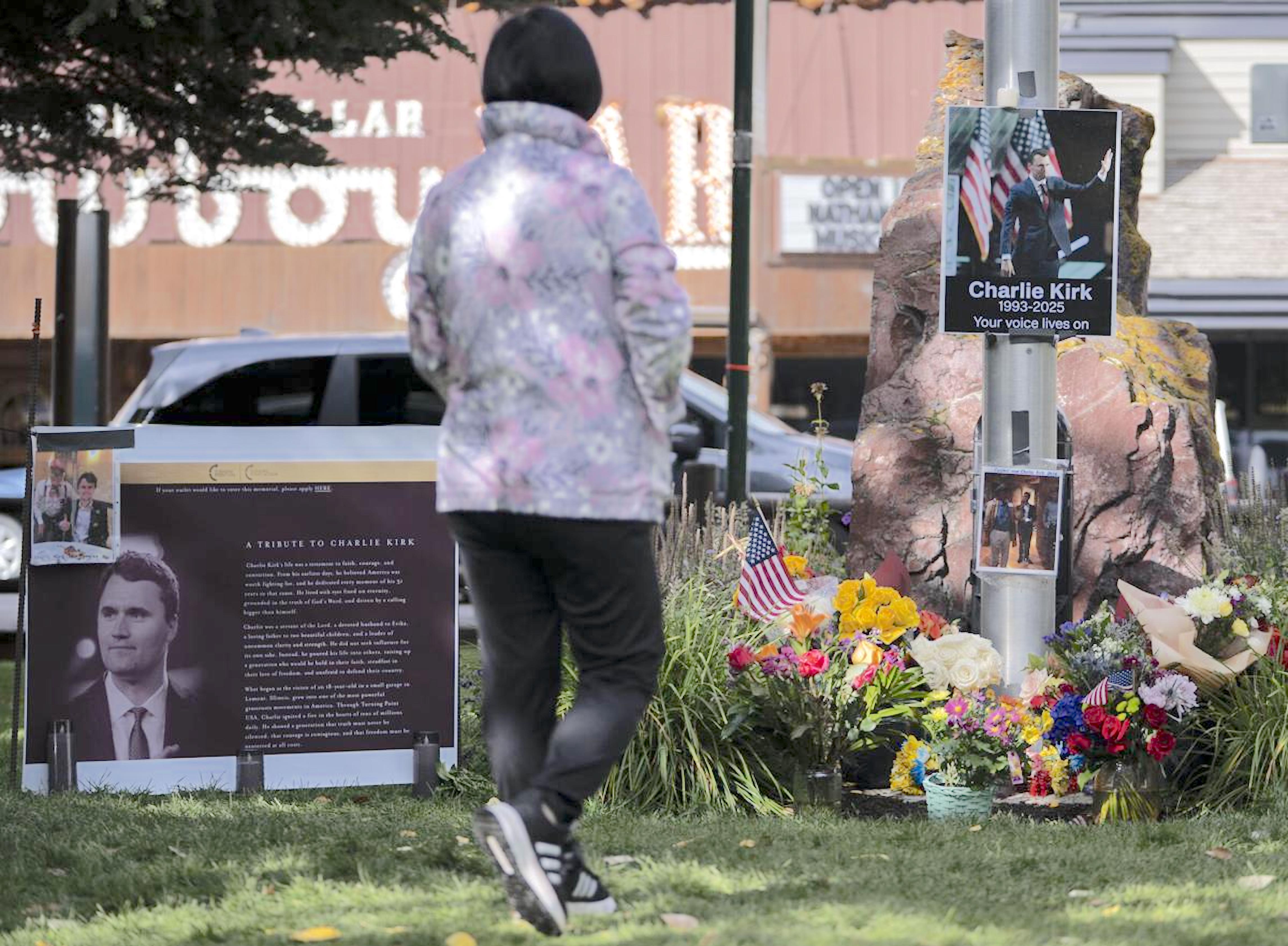
After political violence, residents consider the meaning of ‘reconciliation,’ debate how to get there.
JACKSON — After conservative icon Charlie Kirk was assassinated last week in Utah, Jacksonites across the political aisle called for unity and peace, denouncing political violence.
But opinions differ on the meaning of reconciliation. Many of Kirk’s admirers in Jackson say strengthening America’s ties to Christian faith and morals is necessary to bring the nation together. Others said the solution lies in amplifying rather than silencing neighbors’ voices.
“For our country to move forward, we need to return to a nation under God,” Rev. David Bott told the News&Guide Tuesday morning after hosting a memorial service for Kirk at Redeemer Lutheran Church.
The Lutheran church’s Monday night service was just one example of how western Wyoming has responded to what Teton County GOP Chair Kat Rueckert called “the shot heard around the world.”
Kirk was shot and killed Sept. 10 during an appearance at Utah Valley University’s Orem campus. On Tuesday, the Salt Lake Tribune reported that Tyler Robinson, accused of fatally shooting Kirk, now faces aggravated murder charges. If Robinson is convicted, prosecutors said they will seek the death penalty.
In the wake of the shooting, Wyoming politicians condemned political violence. A Jackson singer hosted a vigil on Town Square encouraging love. Residents spent the week reflecting in private and public on a death they feel is only further dividing the country.
In the past year, politically-fueled violence has rocked the United States. President Donald Trump survived two assassination attempts on the campaign trail. One Democratic state lawmaker in Minnesota was shot and killed, along with her husband. Another Democratic lawmaker was shot but survived alongside his spouse.
Kirk, a prolific organizer of conservative youth, co-founder and CEO of Turning Point USA and host of “The Charlie Kirk Show” podcast, was a controversial figure over more than a decade of activism. He’s often credited with winning the young adult vote for Republicans, most notably President Donald Trump, reconnecting Americans with Christianity and upholding the right to free speech.
Groups like the Southern Poverty Law Center were critical of Kirk’s messaging, saying his strategy was “sowing and exploiting fear that white Christian supremacy is under attack by nefarious actors, including immigrants, the LGBTQ+ community and civil rights activists.”
But this week Kirk’s supporters in Jackson countered, saying that his words were often twisted, that he spoke only fact and truth and that he was a conservative martyr.
“It’s a loss for the country,” said Lynn Friess, an active Jackson philanthropist.
Friess was married to the late Jackson billionaire Foster Friess, who met Kirk when he was starting out and gave one of the first major donations to Turning Point USA. Over the years, the couple donated to Kirk and Turning Point countless times, and introduced him to other backers.
“He didn’t waste a cent, let me tell you,” Friess said of Kirk. “He really had a great plan for what he was going to do.”
On Monday, Friess announced that she is donating $1 million to support thousands of new Turning Point USA chapters that are springing up across the country. She was inspired by Erica Kirk’s address to the nation, pledging that her husband’s work will continue.
Friess also doesn’t think that Kirk’s vision will fall to the wayside after his death. Admirers consider him an example to live by.
Different kinds of connection
Rueckert, chair of the Teton County GOP, said in a statement on Monday that Kirk loved God, his family and his country — in that order.
“May we all be a little bit more like Charlie,” she said.
Kirk’s supporters have felt the magnitude of his death so intensely because of his “tremendous and authentic influence on the political, social and biblical landscape of our modern time,” she said. Rueckert added that the community could rebuild by finding Jesus, praying, discovering a God-given calling, and learning something new every day.
“You can’t have unity if you don’t have a moral foundation, so begin by finding your faith, then expand,” she said in a statement. “The community gets better only if its people do.”
Teton County Democrats suggested other ways to move forward.
“The Teton County Democrats condemn the use of violence in any form and context to address any perceived grievances or as an attempt to nullify political discourse,” Annette Osnos, the chair of the Teton County Democrats, said in a statement. “This is not a new kind of event in our country. When it happens it is incumbent upon all of us to both morally reject it and to redouble our efforts to peacefully negotiate our differences.”
She said casting blame doesn’t help solve problems.
Rep. Mike Yin, D-Jackson, encouraged people to spend time in the community, have meaningful conversations and to get outside and enjoy public lands this fall. The Internet only fuels more anger, he said, and Wyomingites all share their desire for good education, housing, and job opportunities — and keeping young people in the state.
“It’s easy to see villains in everything,” he said. “It’s harder to do the actual work and sit down and chat with our neighbors and friends.”
Fears of persecution
After Kirk’s death, people are choosing to define what unity means to them, said Rep. Nina Webber, R-Cody, a member of the Wyoming Freedom Caucus. She spoke with the News&Guide after attending the Monday memorial service.
“It’s igniting the conservative movement,” Webber said of Kirk’s assassination. “It’s igniting his belief in God and conservative values, and saying, ‘Hey, it’s okay to be different. It’s okay to push our Christian values.’”
Bott’s sermon focused on the persecution of Christians throughout history, starting with efforts to eliminate Christianity in Rome.
“We are being put to death all day long,” Bott said, quoting the Apostle Paul. “We are considered as sheep to be slaughtered. But in all these things, we overwhelmingly conquer through Him who loves us.”
“As sheep to be slaughtered,” Bott said, beginning to preach, rather than read from scripture. “That’s not hyperbole. That’s not a metaphor either.”
How else, Bott asked, could a 22-year-old man look through a rifle scope at a Christian husband and father and press the trigger?
Christians shouldn’t be surprised when they are asked to make the ultimate sacrifice for their faith, he said.
“Don’t plan on it being an if, but when,” he said.
His Monday night sermon resonated with many attendees.
Katsey Long, a Roman Catholic and longtime Jackson resident, said she feels that American Christians are being targeted. She pointed to the attack at a Catholic School in Minneapolis that killed two students and injured 21 others last month.
She considers Kirk’s death a “turning point.”
“People are not going to be silent,” Long said. “I think that shot raised up a sleeping giant and we’ll see what happens. Not a movement of violence, a movement of peace and reconciliation, but we’re not going to lay down and take it.”
Long disavowed “name calling” or “rejoicing in someone else’s misery,” because she worked for the late Father Ubald Rugirangoga, a Catholic priest who survived the 1994 Rwandan genocide and often visited Jackson. After losing 4,000 of his parishioners as a pastor and 80 of his own family members, he worked tirelessly to bring about forgiveness, peace and reconciliation.
“He brought that same message to America,” she said of Ubald.
This story was published on Sept. 17, 2025.