


House maintains Wyoming Business Council cuts, among others
CHEYENNE — The Wyoming House of Representatives put forward 122 proposed amendments to its version of the state’s budget for the next two years. After more than 11½ hours of discussion Tuesday and the early hours of Wednesday morning, the chamber only made it through 52 of those.
Only six were approved, and six others were withdrawn from consideration.
As the House is typically expected to consider all proposed amendments on the day of the reading — whether that be first, second or third reading — Wyoming’s 68th Legislature took an abnormal, unexpected approach to continue discussions through a second day.
Shortly after 1:30 a.m. Wednesday, the body ended discussions until 10 a.m. to rest.
As a technicality, the body voted to go “into recess” instead of adjourning to allow the House to continue discussions later Wednesday.
Between Wednesday early morning, late morning and afternoon sessions, lawmakers discussed a slate of proposals that could have longstanding impacts on the state budget. At the time of publication, the House had made it through 105 of 122 proposed amendments on second reading.
Third reading must occur more than one day after second reading, and it is currently unclear whether it will occur Friday, this weekend or sometime next week.
Wyoming Business Council
The 27-33 vote in opposition to an amendment to restore funding for the Wyoming Business Council on second reading leaves the state’s primary economic development agency facing a nearly total loss of operational funding as the budget session continues.
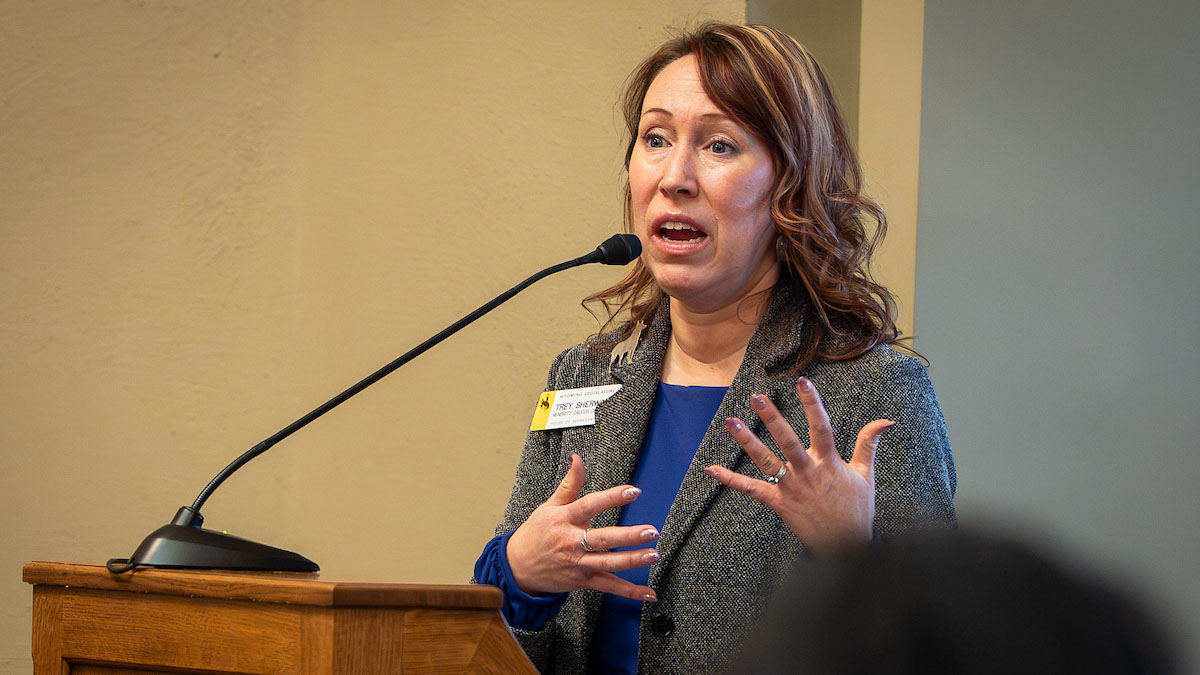
The failed amendment, brought forward by Rep. Trey Sherwood, R-Laramie, sought to reinstate the agency’s standard budget and preserve 38 full-time employees and two intern positions. Without these funds, the WBC is left with only $2 million earmarked by the Joint Appropriations Committee to manage existing loans, a move that Gov. Mark Gordon has likened to hanging a “closed for business” sign on Wyoming’s borders.
Rep. Landon Brown, R-Cheyenne, defended the agency, citing its impact during the 2018 sugar beet freeze, the 2020 Goshen County tunnel collapse and the distribution of $320 million in CARES Act funding. He expressed concern for the human cost of the vote, noting that eight employees in his district would lose their livelihoods.
“These people have lives, they have mortgages, they have kids ... and their jobs are gone by the act of this,” Brown said.
However, opponents of the funding argued that the state has not seen a sufficient return on its investment.
Rep. Steve Johnson, R-Cheyenne, pointed to testimony suggesting the agency spent $49.2 million in 2024 but created only 28 jobs.
“We cannot afford this,” Johnson said. “We need to cut off the credit card and stop this mess.”
Other lawmakers, such as Rep. Scott Smith, R-Lingle, suggested that taxpayer dollars would be better spent on physical infrastructure like water treatment plants and irrigation districts, rather than economic development programs. He argued that the free market — specifically private banks — is better equipped to assess risk and provide loans.
Rep. Ken Pendergraft, R-Sheridan, was also critical, stating that when he looks at what the agency has become, there is “virtually nothing salvageable.”
The failure to restore funding creates uncertainty for the future of economic development in the state.
Rep. Lloyd Larsen, R-Lander, warned that the WBC currently oversees $348 million in federal broadband expansion funds. He questioned who would manage these complex programs if the agency’s expertise were dismantled, noting that the governor’s office may not be up to speed on the requirements.
Proponents of the WBC also argued that losing the agency puts Wyoming at a competitive disadvantage as a “talent exodus” continues among the state’s youth.
Since the Senate’s proposed 2027-28 biennium budget maintained funding for the WBC at the time of publication, it remains uncertain how the Legislature will agree on funding for the state’s economic development agency.
Sun Bucks denied
Though lawmakers had been debating amendments for going on 10 hours at this point, the final amendment discussed in the early hours of Wednesday morning still generated passionate and thorough debate.
Sun Bucks provides onetime, per-child grocery benefits to income-eligible families during summer months. It would serve an estimated 32,000 children in Wyoming. The amendment arose after the topic was brought up by the Wyoming Department of Family Services during the interim.
However, critics likened the amendment to socialism, and said it is often a failure of communities that learn to lean too heavily on government.
“At the end of the day, are we really wanting to hand kids a card and (tell) them, ‘Hey, anything you need, the government’s there for.’ But what are we teaching them?” Rep. Jeremy Haroldson, R-Wheatland, asked.
“Let’s reject expansion of welfare dependency. This adds another layer of federal handouts with EBT cards,” said Rep. Rachel Rodriguez-Williams, R-Cody.
Rep. Ivan Posey, D-Fort Washakie, said it is not socialism.
“I’m not dependent on the government,” he said, referencing commodities that were distributed to his family and other Native Americans during his upbringing. “I don’t think it leads to a dependence further down the road for some people — at least it didn’t with me and some of my siblings. But I really think we can’t go after kids that are poor.”
Rep. Karlee Provenza, D-Laramie, referenced the recent prayer, delivered by Haroldson, a pastor, given at 12:01 a.m. Wednesday to kick off the new day.
“Our budget is a moral document. And I’m struggling with why we open with prayer but then punish kids for the circumstances of their parents. ‘I was hungry and you gave me nothing to eat. Whatever you did not do for the least of me, you did not do for me,’” Provenza said, referencing Scripture.
Haroldson responded, saying a negative vote on this amendment does not punish children.
Ultimately, the amendment failed on a vote of 26-34.
State Park land
Amendment 30, proposed by Rep. Steve Harshman, R-Casper, sought to allocate $6.5 million from the general fund to create a new state park in Natrona County.
The proposal involved purchasing specific parcels of land currently held in the common school trust. Harshman described the transition as moving money from the state’s “right pocket to left pocket,” explaining that while the state technically owns the land, the general fund must pay the school trust account fair market value to repurpose it for recreation. This would ensure the trust fund for students remained while allowing Wyoming State Parks to manage the area.
However, Rep. Steve Johnson, R-Cheyenne, questioned the necessity of the deal.
“I just can’t see the logic in this. We’re going to buy something we already own,” he said.
Other lawmakers raised concerns regarding a pending court case over existing leases on the land. Despite Harshman’s plea to resolve a longstanding “aggravation” in the community and protect local geology, the House was perfectly split.
The amendment failed in a tie vote of 30-30, leaving the $6.5 million in the general fund, rather than transferring it to the school trust.
Clarifying abortion restrictions
The House also adopted an amendment that inserts the word “elective” before every mention of “abortion” within the budget’s restrictive footnotes.
The amendment ensures that the prohibition on using general, federal or other state funds specifically targets elective abortions and the facilities or equipment used to perform them.
UW secures athletic funds
Despite failing to secure the $40 million in block grant funds, University of Wyoming athletics received a boost through the adoption of an amendment that increases the general fund appropriation for UW state aid by $6 million for the upcoming biennium. It passed on a 35-25 vote.
This story was published on Feb. 19, 2026.