


The great fence post controversy
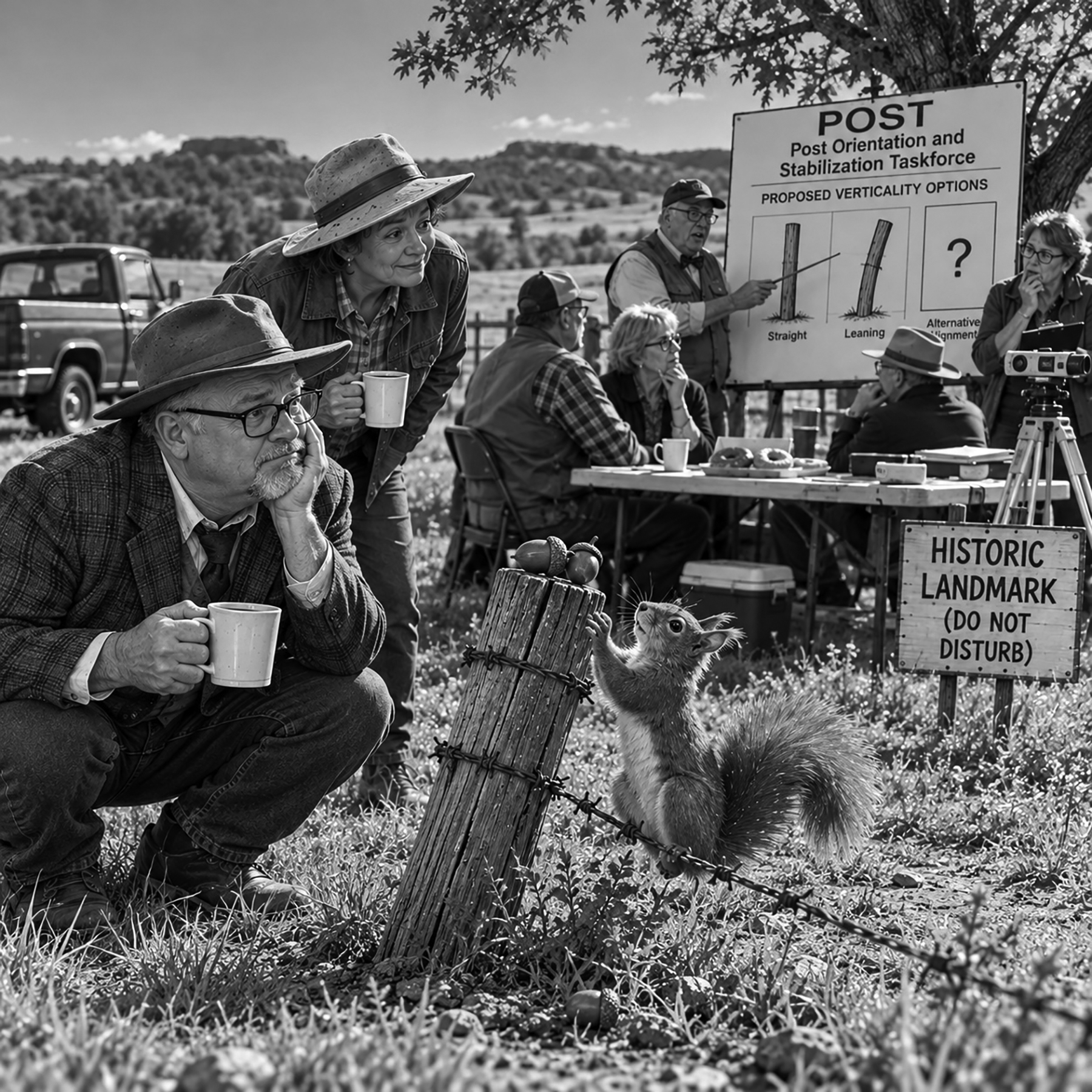
It all started with a fence post. Not a particularly important fence post. It wasn’t holding up a gate, restraining a prize bull or marking the international boundary between hostile nations. It was simply leaning.
Harold Jensen noticed it Tuesday morning while checking cattle. The post had been there 40 years, leaning east for at least 30.
Harold gave it a shove with his boot.
“Yep,” he said.
That concluded his investigation.
He intended to straighten or replace it Saturday, assuming nothing more important broke down, which on a ranch generally means sometime between Saturday and the Second Coming.
Unfortunately, Harold mentioned the post to his neighbor, Vern Pritchard, over coffee.
“Leaning pretty good,” Harold said.
“How much?”
“Enough.”
“East or west?”
“East.”
That should have ended it. But Vern mentioned the conversation to his brother-in-law, who mentioned it to a fellow who’d attended a seminar on rural infrastructure.
By Thursday, the post was a public safety concern. By Friday, a committee had formed.
The Post Orientation and Stabilization Taskforce, or POST, held its first meeting at the coffee shop. Seven people attended. None owned the fence.
Chairman Milton Crandall, a retired insurance adjuster, declared their first responsibility was determining whether the post was actually leaning.
“Can’t we just look at it?” someone asked.
“We need a standardized definition of vertical.”
A motion defining vertical as “straight up and down” failed when someone pointed out the Earth was round. A second motion, “perpendicular to the ground,” failed when Bernice questioned whether the ground was level. By the next meeting, POST had purchased a carpenter’s level, two measuring tapes, a clipboard and doughnuts. The doughnuts passed inspection unanimously.
Meanwhile, Harold and Vern drove past the post every morning.
“Still leaning,” Vern observed.
“Yep.”
“Gonna fix it?”
“Saturday.”
“Which Saturday?”
“One without a committee.”
The controversy intensified when Milton measured the lean at 3.7 degrees. Bernice insisted it was 4.2. Another member suggested the post might also lean north. An emergency meeting was called. POST had now spent $86.43 investigating a post Harold could replace for six dollars.
Someone suggested a grant. Another proposed declaring the post a historic landmark, requiring an environmental impact study before anyone touched it. Harold finally attended a meeting.
“Folks, I’ll pull it out, put another one in, and we’ll all go home.”
Milton shook his head.
“I’m afraid we’ve moved beyond that.”
“Beyond what?”
“The post.”
Harold looked at Vern. They went fishing.
I stumbled upon the controversy at the coffee shop, where Milton stood beside a poster labeled PROPOSED VERTICALITY OPTIONS.
Three diagrams showed a straight post, a leaning post and a question mark.
“What’s that one?” I asked.
“Alternative alignment.”
“Milton, it’s a fence post.”
“That’s exactly the oversimplification we’re trying to avoid.”
He explained that POST was considering a subcommittee to determine whether the post qualified for a grandfather clause.
Saturday, POST assembled at Harold’s pasture for an official inspection. I heard about this and had to attend, needing a good laugh.
Milton brought a tripod. Bernice brought a measuring tape. Somebody brought refreshments. Harold brought a shovel.
“Let’s get this over with.”
That’s when a gray blur shot across the pasture.
It was Rocky. That damned squirrel raced up the leaning post and began chattering at the committee.
“Nobody move!” Milton shouted. “We have a wildlife consideration!”
“Is it endangered?” Bernice asked.
“Not nearly enough,” I muttered.
Rocky produced an acorn and balanced it atop the post. Then another. Then a third.
“Good heavens!” Milton exclaimed. “He’s conducting a load-bearing test!”
Rocky jumped.
The rotten post creaked, snapped and fell flat.
Harold picked it up and tossed it into his truck.
“Well, that settles that.”
“Not necessarily,” Milton said. “We must determine whether the empty hole constitutes a hazard.”
Vern climbed into Harold’s truck.
“Fish are biting.”
As they drove away, Rocky stole the last doughnut and climbed a cottonwood.
POST immediately declared the fallen post a historic landmark and voted to preserve the hole in its original condition.
Bernice proposed a protective fence around it. Milton agreed.
“Naturally, we’ll need posts.”
“How many?” I asked.
“Four.”
“Who’s installing them?”
Milton consulted his clipboard.
“Harold.”
I looked toward the pasture. Rocky had returned and was burying an acorn in the historic hole.
Bernice gasped.
“Unauthorized excavation!”
Milton called an emergency meeting and appointed Rocky chairman of the new Wildlife Excavation and Environmental Division. He immediately applied for federal funding to study Rocky’s activities, establish WEED headquarters and purchase an official squirrel-sized executive chair…
“How much?” I asked.
“Half a million dollars.”
“For a hole?”
“Don’t be ridiculous,” Milton snapped. “For the squirrel.”
Rocky chattered from the fence.
“See?” Milton said. “He’s already submitted his budget request.”
Bernice nodded solemnly.
“Shouldn’t we conduct a background check before appointing him?”
“We did,” Milton replied. “He’s got a history of stealing nuts, destroying property and trespassing.”
“Then why on earth did we appoint him?”
Milton looked offended.
“He’s the only applicant with government experience.”
FYI, I really hate that squirrel.