


Funding national parks — The president and Congress have 3 plans to fund park service
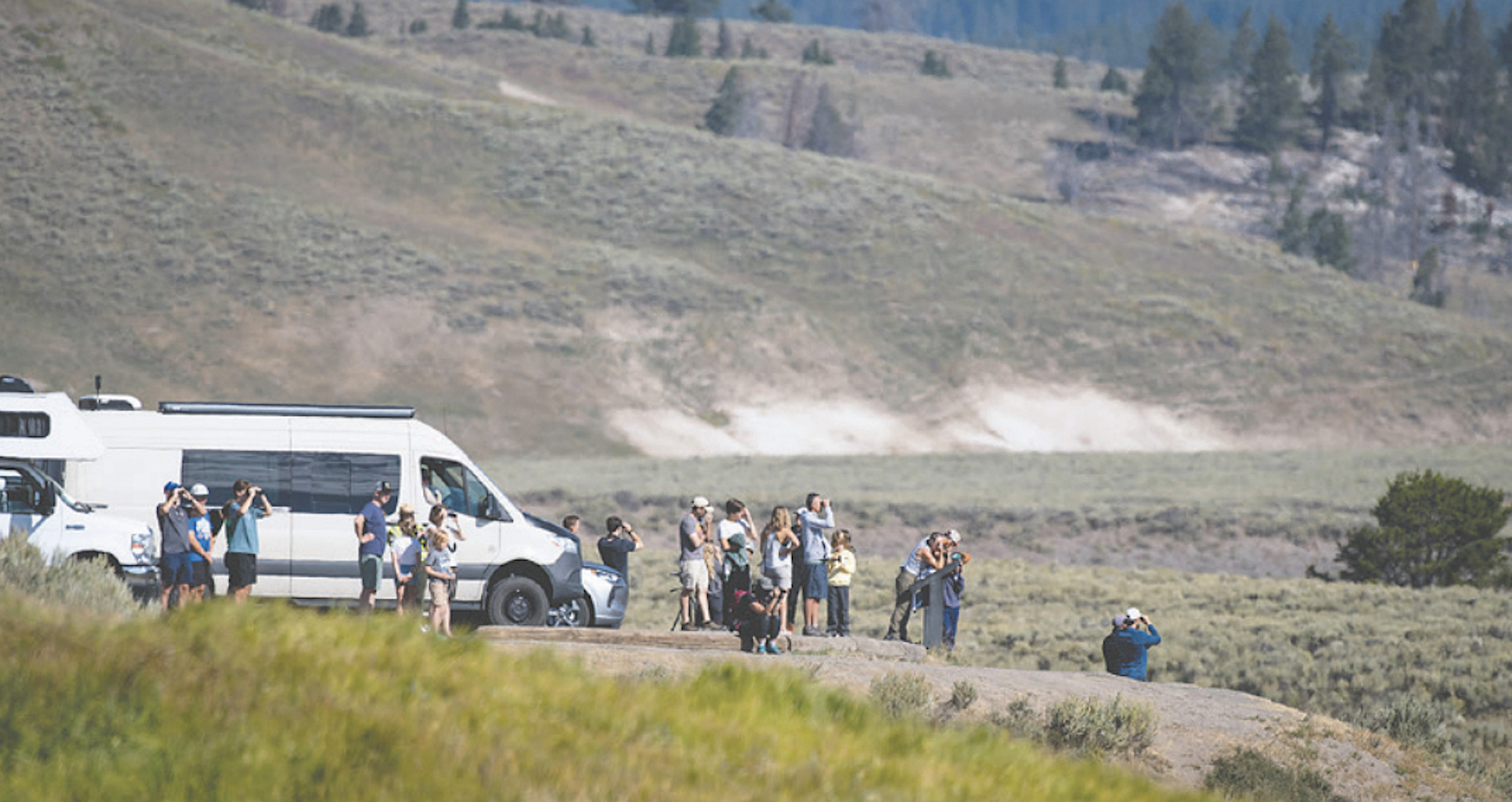
Visitors flock to Yellowstone National Park, which, despite many recent challenges, has posted several attendance records approaching 5 million in the past five years. Meanwhile, employment numbers have remained flat since the turn of the century when there were about 1 million fewer visitors per year. Photo by Mark Davis, Powell Tribune.
POWELL — At the turn of the century, Yellowstone National Park issued its first State of the Park report. The report indicated staffing shortages and concerns about insufficient funding, highlighting resource management issues and a lack of staff and suggesting a workforce stretched thin despite its importance.
There were 734 federal full- and part-time employees at Yellowstone in 1999 versus about 750 employees in 2023 (the last year reported), but the small increase in staffing has come with a large increase in visitation.
There were approximately 1 million fewer visits per year in 2000 than 2024, the latter being the second most visitors in park history.
While the park has gotten ever more popular, funding challenges remain and don’t look to be going away anytime soon.
With the new year comes yet another battle to agree on a federal budget, one part of that being funding the National Park System. There are three plans out there between the president, the House and the Senate — none offer an increase to battle rising prices.
Last May, President Donald Trump suggested cutting about a third from the agency’s budget. He wants to cut $1.23 billion from the Park Service, down 36.87% from the 2024 budget’s $3.35 billion to run the 433 properties across the country to $2.12 billion.
The National Parks Conservation Association calls the Trump plan “a blueprint for dismantling the National Park System.”
This comes as the Park Service is experiencing a full-blown staffing crisis, losing a quarter of its permanent workforce since January.
“Parks across the country are struggling to keep gates open and basic services running. Some parks are scaling back visitor center hours, while others are delaying critical maintenance and research, putting the long-term protection of America’s most iconic landscapes and cultural resources in jeopardy,” the Association said in a late summer press release.
Theresa Pierno, the association’s president and CEO, didn’t mince words.
“This is the most extreme, unrealistic and destructive National Park Service budget a president has ever proposed in the agency’s 109-year history. It’s nothing less than an all-out assault on America’s national parks,” she said.
But Congress has offered two separate budget proposals through committees: one that makes modest cuts and one that keeps the budget flat for 2026.
Congress
Budget proposals from the House Appropriations Committee have also opted for cuts, but much less extreme than that of the White House version.
The House put forward a bill cutting 6% – about $176 million from the operations budget and 21% from construction funding – or about $37 million.
While it would hurt, budgets for years have failed to answer for inflation and increased visitation.
Despite the Service hosting a record 331 million visits across all national parks in 2024, budgets have remained flat at best.
The Senate responded with its own bill, unscathed and including protections for public lands.
“The [Senate] bill includes flat funding for the operation of the National Park System, rejecting dramatic cuts proposed by both the Trump administration and House. Instead, it holds funding steady to support staffing, operations and public access across the Park System,” the Association reported.
The protections proposed would require the administration to hire and retain sufficient Park Service staff to perform the agency’s mission to protect irreplaceable resources and ensure visitor enjoyment and safety; forces the administration to give Congress notice of any significant reorganization efforts, as a potential reduction in force could decimate park service staffing even further; blocks the administration’s attempts to deauthorize, sell off or transfer units of the National Park System; rejects the administration’s efforts to divert money from the Land and Water Conservation Fund intended for conservation purposes; requires notification to Congress of any future efforts to cancel National Park Service leases, and forces the timely delivery of grant funds for tribal and other community-driven efforts to protect and interpret historic resources.
What Wyoming wants
In the most recent State of the Rockies poll, Wyoming showed its teeth to those looking to make wholesale changes to public lands, including national parks.
Wyoming residents have said they would rather have qualified experienced habitat and wildlife officials making decisions about wild spaces than the federal government.
In all, 76% prefer decisions about public lands, water and wildlife be made by career professionals such as rangers, scientists, and firefighters rather than new appointed officials who come from other industries, the survey reported.
Even more residents want to protect the right of presidents to enroll national monuments. About 80% believe that existing national monument designations from the last decade should be kept in place.
Another 58% of Wyoming residents oppose giving state government control over national public lands, such as national forests, national monuments, and national wildlife refuges, according to the survey.
And, even in a state that relies on energy to make ends meet, 55% said they prefer that leaders place more emphasis on protecting water, air, wildlife habitat, and recreation opportunities over maximizing the amount of land available for drilling and mining.
The State of the Rockies poll results were based on interviews with 3,376 registered voters in eight states. In Wyoming, 402 voters were interviewed. According to https://www.coloradocollege.edu, the effective margin of error in the poll is +2.4% with 95% confidence for the total sample, and at most, +4.9% for each state.
This story was published on Jan. 6, 2026