


County moves to establish board — EMS district on the horizon for Weston County
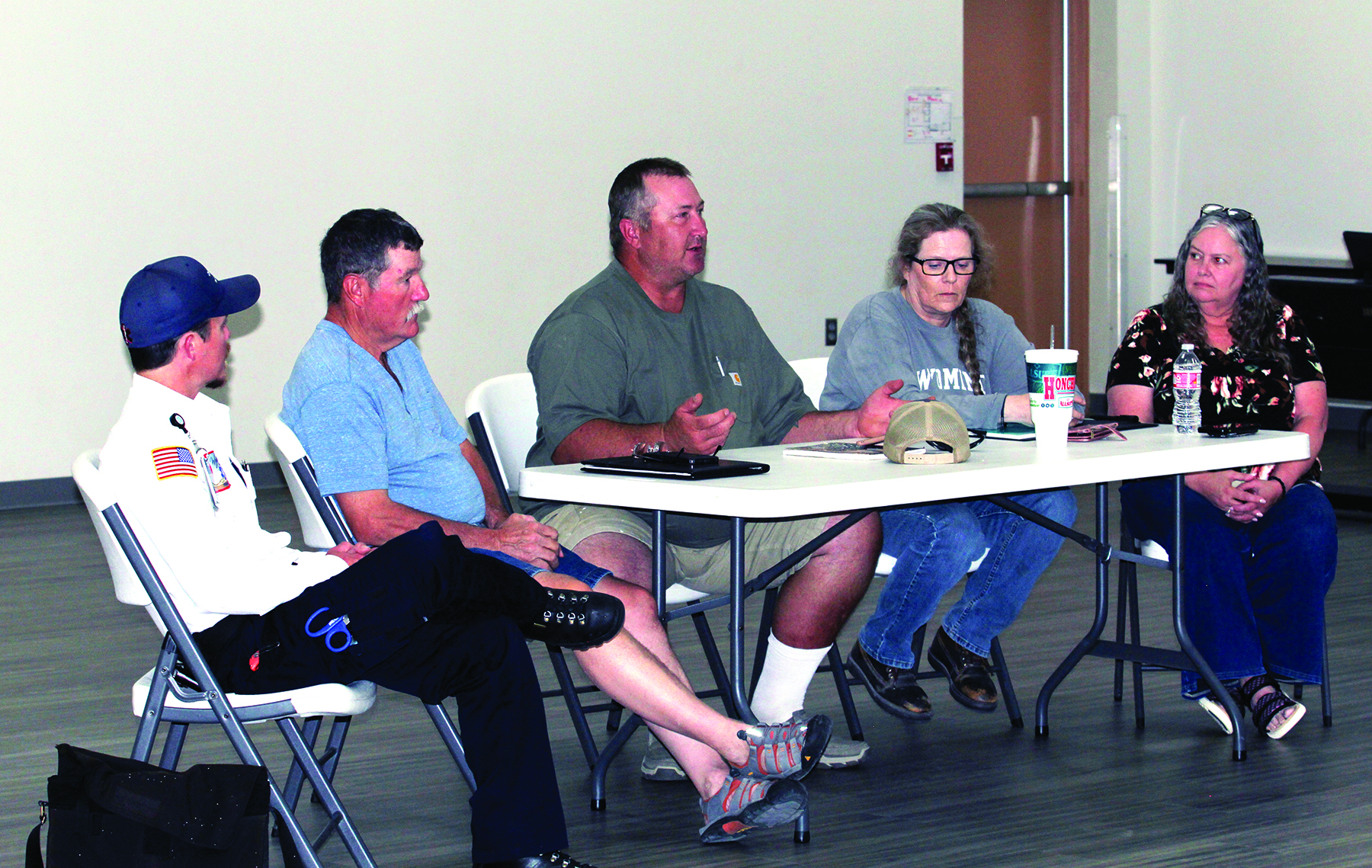
Photo by Walter Sprague/NLJ Shane Kirsch, director of ambulance services for Campbell County Health, sits with members of the Weston County Commissioners on Aug. 18. The commissioners, Ed Wagoner, Nathan Todd, Marty Ertman, and Vera Huber, along with Kirsch, answered questions of the public at the Upton Community Center during an EMS Districting public meeting. About 25 people showed up to voice their opinions and ask questions.
Weston County is moving closer to establishing an emergency medical services district to help fund EMS services in response to continued concerns about staffing and response times.
On Aug. 19, during the Board of Weston County Commissioners meeting in Upton, Chairman Nathan Todd reported that an Aug. 18 meeting in Upton to discuss the county EMS district was well attended and that there was once again significant support for the county’s efforts to establish a district.
During the meeting, the commissioners, EMS leaders and the community discussed creating the district with the purpose of stabilizing ambulance staffing and response. Discussion included reasons why current funding is failing, how a district would work, what it could cost taxpayers and what the raised funds would pay for.
Todd said that the crowd unanimously supported the county’s adoption of a resolution to appoint a board.
Creating the district, as previously reported, would create a county-commission-appointed board of five to nine members that would study the needs and budgets and propose funding.
The funding mechanism would be two mills as a base, if approved by the voters. An additional two mills is allowed but must be reapproved by the voters every four years.
According to information provided during the Upton meeting, two mills would provide a little over $300,000 in annual revenue based on the current county valuation. It was noted that the previously estimated impact on a homeowner would be $80 a year.
The board emphasized that most of the mill revenue in Weston County comes from infrastructure-heavy corporations, including pipelines, railroads, power lines and oil/gas.
Following the Upton meeting, Commissioner Ed Wagoner also expressed his support during the Aug. 19 meeting for moving forward with the district creation. He said he was very much in favor of directing Weston County Attorney Michael Stulken to get started on a resolution.
Todd did assert that he fears that Upton might be left out of the equation and have little to no representation on the board. Because of this, he said, he would like to see representation from across the county.
Commissioner Marty Ertman agreed, saying that they also have to consider those individuals who do not live in incorporated areas and that those people have a voice too.
She said her vision would be for the board to cover the entire county, with representation from the various communities in the county.
Commissioner Vera Huber said that the board makeup would depend on who puts in for those positions but that the commissioners would be amiss if they don’t keep in mind where each of the individuals live. She said that the board needs to be fair, equal and balanced with representation from Newcastle, Upton, Osage and the rural community as a whole.
Huber noted that she believes seven would be a good number.
Ertman asserted that she believes the board makeup would require more discussion, and Todd agreed, informing the board that the topic would be discussed during old business on Sept. 2 after the board had time to think things over. Todd also directed Deputy County Attorney Jeanie Stone to draft a preliminary resolution.
State law
According to Wyoming Statute 18-12-105, a district may be created by resolution of the county commissioners. It also states that the public must be given an opportunity to provide input before the creation is official.
“Not less than sixty (60) days before any resolution pursuant to this subsection is signed, the board of county commissioners shall hold a public hearing and publish the proposed resolution, including the date and time of the public hearing, in a newspaper of general circulation in the county and on the county’s website,” the bill states. “The board of county commissioners shall submit the proposed boundaries of the district to the county assessor and the department of revenue for review for any conflict, overlap, gap or other boundary issue.”
At this point, the assessor and the Wyoming Department of Revenue may also make written comments to the county commissioners before the public hearing, but it will ultimately be up to the voters to decide how much money the district can raise.
County Attorney Michael Stulken said the statute allows for up to four mills to be approved by the voters and board of electors to provide funding for the district.
“If the district was formed under W.S. 18-12-105(b) as a district to provide emergency medical services, the tax for the district shall not exceed four (4) mills if the mills are approved by the board of directors and approved by the electors as provided in subsection (c) of this section,” the statute states.
Subsection (c) states that if the mills are approved by the district’s board of directors, the board of county commissioners “shall call an election within the district upon the question of whether the mill levy should be imposed.”
It notes that the “mill levy is effective only if the question is approved by a majority of those voting thereon within the district providing emergency medical services. The cost of any special election under this subsection shall be borne by the board of directors.”
Subsection (d) further states that “if the proposition to authorize a mill levy is approved, the tax shall remain in effect until a petition to discontinue the tax, signed by not less than ten percent (10%) of the voters of the district, is received by the board of county commissioners, at which time the proposal to discontinue the tax shall be submitted to the voters of the district at the expense of the county at the next general election. If the proposition to impose or discontinue the tax is defeated, the proposition shall not again be submitted to the electors for at least twenty-three (23) months.”
Transfer worries
NLJ Reporter Mary Stroka and NLJ News Editor Alexis Barker
One of the major concerns facing officials in Weston County is the lack of additional EMS crews to transfer patients to other facilities.
“The percentages of the EMS, the ground transfers that we have; they are actually surprisingly low of the transfers that they do take out of here,” Kim Scharf, the director of quality at Weston County Health Services, said at the hospital board’s Aug. 21 meeting.
According to Scharf, the EMS crews typically work a 24-hour shift. The power truck — based in Wright, according to Weston County Health Services CEO Cathy Harshbarger — is a 12-hour shift that is offset from the shift change to try to ensure that any transfers that happen around the time of shift change are handled by the power truck crew.
Harshbarger said that WCHS and Campbell County Health and a representative of Weston County met regarding transfers from WCHS to Campbell County Health.
“911 gets handled – not always super timely - but they are handled, of course we have a big county,” Harshbarger said.
Harshbarger said that WCHS “did some policy,” so it would share staff with CCH but needs “to work with Gillette about an MOU (memorandum of understanding).”
“If we have a really critical patient, we’d like to get them out, so we did some policy so that we can share staff,” Harshbarger said.
Harshbarger said that she would talk to Campbell County Health regarding cost sharing.
She said that her top concern is getting patients to where they need to be for care, not the cost of WCHS’ nurses.
Mayor Tyrel Owens also discussed concerns surrounding transfers during the Newcastle City Council meeting on Aug. 18. He said that during the EMS capacity study they discussed the potential district as a buffer for the amount of subsidy paid to Campbell County Health by local governments.
He noted that those funds would help staff avoid utilizing Life Flight as much as possible. Owens said that he thinks that Life Flight has been in the air too often.