


Cheney was vice president-in-residence for Jackson Hole fishermen, protesters, friends
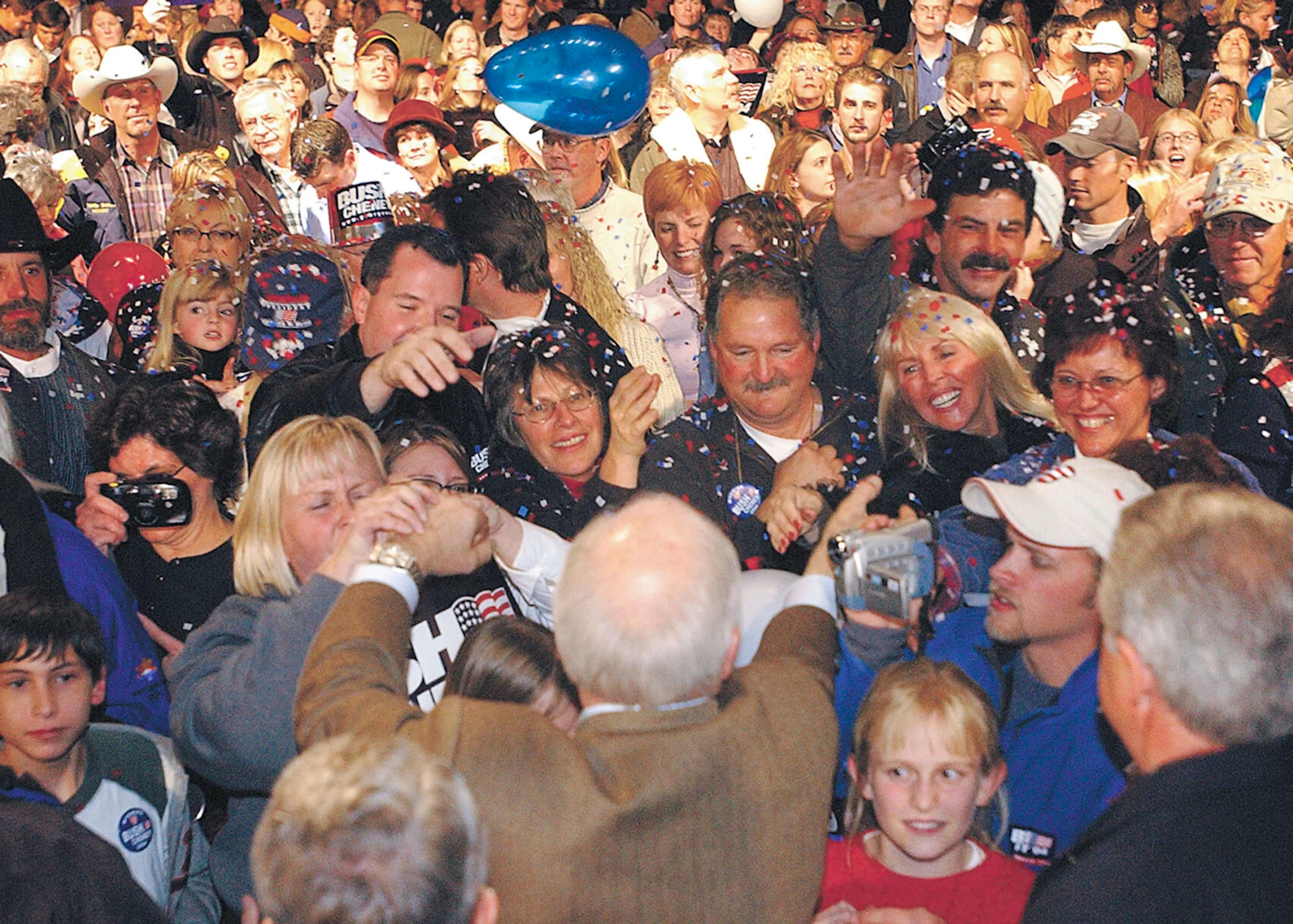
Vice President Dick Cheney mingles with supporters during a rally at Jackson Hole Airport in November 2004. Cheney continued making public appearances in Jackson during his tenure as the second most powerful man in the United States. File photo by Bradly J. Boner, Jackson Hole News&Guide.
Bush’s right-hand man died Monday, leaving a legacy nationally and in Jackson.
JACKSON — In the waning years of the Bush administration, Dick Cheney received a creative gift from people in his inner circle — a group of Teton-based fishing guides.
Sitting by a campfire on the South Fork of the Snake River, the guides presented the vice president with a pair of yellow shooting glasses. Typically reserved for shooting rifles and shotguns, the gifted eyewear had a special feature: Nuclear missiles glued to the lenses.
“We understand you guys are really struggling in the desert to find these weapons of mass destruction,” Fletcher White said, recalling how the guides presented the gift. “We made these to help you and George find them in the desert.”
Cheney laughed, and the guides snapped a picture of him wearing the glasses, letting his guard down while the world was scrutinizing his, and the Bush administration’s, prosecution of the Iraq War. The moment was notable because the people surrounding him weren’t politicos, high-profile staffers, or secret service agents. They were everyday fishing guides. And, like other people in Jackson Hole, including Cheney’s friends and detractors, they were given access to one of the most powerful people in the world.
“Everybody knows somebody that knows somebody that has been involved with him,” said Sherry Daigle, the Teton County Clerk who registered Cheney to vote in Wyoming in 2000, a move that all but confirmed that he would become George W. Bush’s running mate.
Cheney, arguably the most powerful vice president in U.S. history, died Monday night. He was 84.
“The United States and Wyoming will miss a true patriot,” said Jan Larimer, a Teton County resident who nominated Cheney at the 2000 Republican Convention.
For 32 years, he and his wife, Lynne, have been part-time residents of Teton County, living in a house in Teton Pines.
Cheney officially launched his vice presidential bid from the Teton County Clerk’s office in 2000. The night before Election Day that year, Cheney held a jam-packed victory rally at the Jackson Hole Airport, where he’d given interviews as a member of Congress in the ‘70s and ‘80s. And on Election Day, he publicly cast his ballot at the Wilson firehouse before dashing off to Texas to watch election returns with then-candidate George W. Bush, the son of the president who’d picked Cheney as his secretary of defense.
In the intervening years, while Cheney was in the situation room following the Sept. 11 terrorist attacks in New York City, Teton County Sheriff’s Office deputies joined Secret Service agents to protect his house in Teton Pines. Later, after Cheney convinced President Bush to invade Iraq in search of weapons of mass destruction that were never found, Jacksonites protested across Teton County. They knew when he was around by the presence of his security detail, and occasionally bumped into him in town.
When the U.S. military killed Abu Musab al-Zarqawi, a terrorist leader that led an insurgency against the U.S. invasion, Cheney took the call on the South Fork, setting up a satellite phone on a gravel bar.
When he returned to camp, White remembers him saying three words: “We got him.”
Fishing guides, again, had a front-row seat to both history and the personality and politics of one of the most consequential, and controversial, American leaders in the last 100 years.
Later in life, when Liz Cheney ran for congressional re-election and lost, condemning President Donald Trump for his role in the Jan. 6 attacks on the U.S. Capitol, Cheney backed his daughter.
Last year, he said he would vote for Kamala Harris over Trump, a remarkable move for a staunch conservative who critics accuse of pushing the limits of executive power.
On Tuesday, Gov. Mark Gordon ordered flags lowered to half staff.
The Teton County Board of County Commissioners held a moment of silence in Cheney’s honor after Commissioner Len Carlman, a Democrat, praised him for his decade as Wyoming’s lone voice in the U.S. House of Representatives. In that time, he helped to stop the construction of a new dam on the Snake River near Pacific Creek, and was instrumental in passing the 1984 Wilderness Act, which protected the Gros Ventre Wilderness and others around Jackson Hole.
“It would not have happened unless Dick Cheney had personally taken an interest and spent time, energy and sweat,” said Phil Hocker, a longtime Teton County wilderness advocate. “Dick Cheney made that happen.”
Controversial townie
For some Teton County residents who count themselves as fans, or friends, Cheney was a plainspoken, tough statesman with a long history of working in Wyoming politics before heading to Washington. He was known for his resolve in the face of the 9/11 attacks and his ability to navigate the levers of power in Washington, having served as the youngest presidential chief of staff in history.
Despite his tough exterior, those who knew him said he had a quick, self-deprecating sense of humor.
“It was an amazing journey from putting campaign buttons together in our kitchen to speaking on the floor of the national convention,” said Larimer, the Teton County resident who nominated Cheney at the 2000 convention, calling it a “great moment for Wyoming.
“Dick loved living in Jackson Hole. When the rest of the world heard he was at an ‘undisclosed location,’ we all knew that probably meant he was at home or on the river,” Larimer said. “It was a special time to have a Jackson local working on the world stage.”
For others, Cheney was a villainous figure, the man behind the expansion of American executive authority that underpins what they see as the ills of the Trump administration. Those people decry Cheney’s backing of an expanding surveillance state after 9/11. They dislike his development of a national energy policy with the input of hundreds of oil and gas executives over environmentalists, and they decry his embrace of foreign wars and assertion that there were weapons of mass destruction in Iraq, even though there were none.
“They were lying,” said Tat Maxwell, a former Jacksonite who protested Cheney almost every time he came to town in the eight years of the Bush presidency. “I protested him for all those eight years mostly because I felt like it was really important to stand up for the first amendment and the right to protest. I just didn’t want him to have a pass while he was in Jackson.”
Returning movies
Maxwell, the descendant of an anti-nuclear activist in Cheyenne who was friends with Cheney’s predecessor in Congress, Teno Roncalio, disagreed with Cheney vigorously, but said he remained “pretty pleasant,” telling her “good afternoon,” and having short exchanges like wishing one another a happy New Year. At one point, going to rent a movie at Main Event, she pulled up and saw Cheney’s motorcade outside. When she went in to return a movie, her daughter, Marrakech, followed her inside.
“Where’s ‘Bush Cheney’?” her daughter asked. “I want to meet him.”
Cheney was at the checkout counter, wearing a Carhartt jacket with an elk embroidered on the back. Marrakech walked up to the vice president, who didn’t acknowledge her. But, when Maxwell tried to get her daughter to leave, she refused, and said she wanted to say “Hi” to him.
Cheney walked towards the exit where Marrakech was standing with her hands on her hips. She said, “Hi,” Cheney said, “Hi,” and then Marrakech turned to her Mom and said, “Mama, he’s not that creepy.”
Embarrassed, Maxwell scooped up her daughter and ran out the door. She doesn’t know, exactly, how Cheney responded. But she has an idea.
“I can imagine he would’ve actually laughed,” she said.
Security detail
In Jackson, Cheney’s presence was unavoidable. Before 9/11, he was often spotted at Pearl Street Bagels, and at Jackson Hole Mountain Resort, where he wore rear-entry ski boots and blue jeans — “what you’d expect from a kid from Casper,” according to Jerry Blann, the former president of the ski hill. One day, Blann spotted Cheney in that getup and approached him about it, encouraging him to get some more modern ski gear.
“Oh no, I’m doing fine,” Blann recalled Cheney responding. “That’s sort of the way I do things.”
But Cheney’s public appearances changed after the Sept. 11 attack.
For Jackson Hole law enforcement, which was used to dealing with senators and celebrities like Harrison Ford, the vice president of a country that had just been attacked was a much bigger deal.
After the attacks, when Cheney arrived in Jackson, he’d move through town in a large motorcade. The Teton County Sheriff’s Office tactical team received training from the U.S. Secret Service, and traveled with the service as a point of connection with local officials.
“It went from, ‘You never knew where or when Cheney was going to show up at the bagel store,’ to, ‘The dude’s not going anywhere,” said Teton County Sheriff Matt Carr, who responded to Cheney’s house on 9/11.
The revealing river
The one place Cheney continued going in the Teton area — and bringing his security detail with him — was the river, typically the South Fork of the Snake, where he’d fish with his family and friends. Those trips were huge ordeals, with Cheney in one drift boat, another drift boat in front and behind, and jet boats in the front and back of the convoy, filled with Secret Service agents. More would be stationed along the river — and not all of them were comfortable.
“You want to see a duck out of water, you should see a Secret Service agent on the South Fork in the middle of the night with a trench coat, freezing his ass off,” said White, the former owner of WorldCast Anglers who guided Cheney when he was vice president.
Security detail aside, Cheney was usually chummy and charismatic on those trips, displaying a sense of humor that wasn’t often seen by the American public.
Cheney struggled with heart problems, and always wore waders on the river, even if it was 100 degrees. When White asked him about that, Cheney said, “Could you imagine a picture on the front page of the New York Times with me in shorts? It would not go over well.” At other times, he put his hand on his heart and wobbled back and forth, feigning a heart attack.
“It’s instantaneous how fast people would run over to him,” Fletcher said.
But Fletcher, who considers himself a political moderate, said Cheney would also get into the details with the guides, explaining his thinking, talking politics, and taking jokes. In the seven years he spent with Cheney on the river, Fletcher doesn’t remember him ever showing remorse or regret for actions he took in office. But, by the time the guides gave him shooting glasses with weapons of mass destruction attached to the lens, Fletcher noticed a change.
“He was starting to think this is going to be a forever war,” Fletcher said. “That’s just my personal opinion. He never looked at me and said, ‘This was a mistake.’ But I could tell he was softening over there and it was wearing on him.”
This story was published on Nov. 5, 2025.