


Call of flight — Veteran hopes for 100th-birthday return to sky
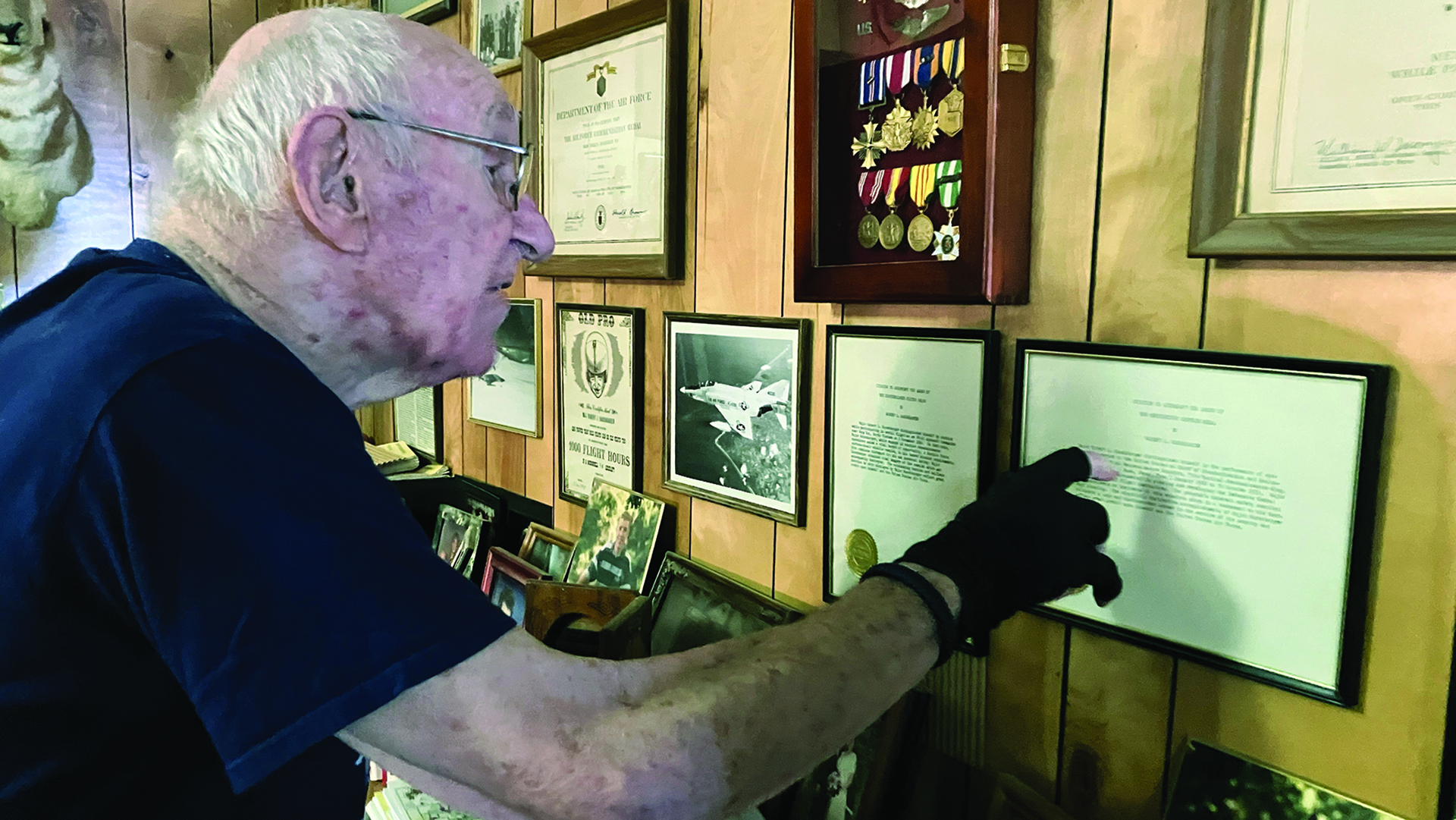
Photo by Mary Stroka/NLJ Maj. Robert “Bob” Harshbarger, retired, points to one of the many certificates documenting his time in the U.S. Air Force. At 97, he is hoping to fly again on his 100th birthday.
At 97, retired U.S. Air Force Maj. Robert L. “Bob” Harshbarger still has an airplane waiting in a hangar at the historic 4W Ranch.
The Navion, nicknamed “Bumblebee,” has been his since 1980 and carried him on birthday flights well into his 90s.
Harshbarger said he continued flying until about two years ago, taxied the airplane last year and did not take it out of the hangar this year.
But this pilot who has accumulated approximately 10,000 hours in the air has one more flight in mind, if he lives to be 100.
“I would sure like to fly that airplane on my 100th birthday,” said Harshbarger, who lives with his wife, Jean, on the ranch.
The goal is fitting for a man whose life has been shaped by what he calls the “flying bug” — from Cold War interceptor duty to 100 combat reconnaissance missions over Vietnam and, later, quiet flights above northeastern Wyoming.
Harshbarger enlisted in the U.S. Air Force on Oct. 20, 1950, after leaving college, where he had been studying to become an industrial arts teacher.
He had considered joining the U.S. Marine Corps but chose the Air Force because his draft notice arrived the same day he went to enlist and being drafted would likely have sent him to the U.S. Army.
After basic training at Lackland Air Force Base in Texas and technical training at Lowry Air Force Base in Colorado, Harshbarger became a radar gunsight mechanic at Bergstrom Air Force Base near Austin, Texas.
He entered aviation cadet training in August 1952 and received his commission as a second lieutenant and his aeronautical rating as an aircraft observer in all-weather fighters on Feb. 25, 1953.
He later served as a radar observer with the 96th Fighter-Interceptor Squadron at New Castle County Airport near Wilmington, Delaware. Harshbarger was nearing the end of that assignment in 1956 when he reconsidered leaving the service.
“The flying bug had hit me very hard,” he said.
He entered pilot training just three days before his 27th birthday, the age cutoff, and graduated in July 1957.
By 1962, Harshbarger was training as a reconnaissance pilot in the RB-66. He later joined the 30th Tactical Reconnaissance Squadron, 10th Tactical Reconnaissance Wing, at RAF Alconbury in England.
Harshbarger and navigator Phil Schacht won NATO’s Royal Flush IX competition in May 1964 as the outstanding aircrew in the night competition, earning selection to represent the wing at events, including a Battle of Britain flyby.
In 1965, Harshbarger transitioned to the RF-4C Phantom, a reconnaissance aircraft capable of exceeding twice the speed of sound at sea level. He flew the Phantom for more than five years, logged 1,500 hours in it and reached Mach 2.3 — approximately 1,764 mph — on his fastest flight. The speed came without much sensation, he wrote; only the instruments revealed how fast the aircraft was moving.
Orders for Vietnam came in 1966, and Harshbarger joined the 16th Tactical Reconnaissance Squadron at Tan Son Nhut Air Base near Saigon.
Leaving for military service in 1950 had felt like the beginning of an adventure, he said, but leaving for Vietnam was different because he had a wife and family. The possibility that he might not return remained in his thoughts.
“I knew I had to go,” Harshbarger said. “It was part of my job.”
Harshbarger flew 100 combat reconnaissance missions in North and South Vietnam — 90 at night and 10 during the day.
The reconnaissance crews’ motto was “Alone, Unarmed and Unafraid.”
Unlike fighter-bombers flying in formation, Harshbarger and the officer in his back seat entered enemy territory alone, carrying cameras and intelligence-gathering equipment but no weapons. On missions over North Vietnam, Harshbarger typically crossed the demilitarized zone about 500 feet above the ground at approximately 560 mph. As he approached a target, he climbed to about 3,500 feet and held the airplane straight and level while its cameras captured 10 photographs, each illuminated by a photo-flash cartridge. The flashes disclosed the aircraft’s position and direction to enemy gunners, making those seconds the most vulnerable part of the mission. Harshbarger accelerated toward the speed of sound while the photographs were taken, then descended in a turn toward treetop level, outrunning the ground fire.
In a reflection written years later, Harshbarger acknowledged the thought that remained in the back of his mind despite the squadron’s motto: “Is this the night the bastards are going to get me?”
He received the Distinguished Flying Cross after a daytime mission in which he and his back-seat officer located and photographed a suspected surface-to-air missile site north of the demilitarized zone. Fighter aircraft destroyed the site later that day, he said.
Harshbarger also received eight Air Medals during his Vietnam service.
He said some unrecognized missions were more dangerous, including one in which he photographed a heavily defended supply depot after eight fighter-bombers had attacked the surrounding defenses. As the fighters descended, anti-aircraft fire erupted beneath them and appeared as though the ground, glowing orange, was rising toward the aircraft.
Harshbarger waited for about 10 minutes over the South China Sea, then turned back toward the target at low altitude and near-sonic speed to photograph the results.
There were no witnesses in his airplane beyond his crewmate and no award recommendation followed.
“It was just a job,” he said.
When the aircrews returned from night missions, they gathered in a rooftop area at their quarters, Sam’s Inn, to exchange “horror stories” over a cold beer.
One of Harshbarger’s most frightening memories, however, did not occur in the air.
Returning to Sam’s Inn on a Honda 90 motorcycle around 1 a.m., he spotted something ahead on a dark Saigon boulevard emptied by curfew.
It was an elephant accompanied by several Vietnamese people.
Harshbarger slowed, drew his .45-caliber sidearm and switched off his headlight before creeping closer and then speeding past.
“That scared the living daylights out of me,” he said.
After Vietnam, Harshbarger became an instructor pilot, preparing RF-4C crews for combat and taking new pilots and navigators on Mach 2 training flights. He retired as a major in 1970, after 20 years in the Air Force.
Military retirement did not end his time in the cockpit.
Harshbarger logged approximately 4,000 military flying hours and another 6,000 hours in general aviation.
On his 92nd birthday, June 23, 2021, he took Bumblebee from the 4W Ranch airstrip into a clear Wyoming sky.
“Now, the Bumblebee and I were free, free from the bounds of earth and all that goes with being on earth,” he wrote afterward. “We were free to enjoy the air space that was now our environment.”
He cruised above the Cheyenne River, performed lazy eights and chandelles, and made a couple of low passes over the house for guests before landing.
“I do tend to show off when there are folks around,” he wrote.
Harshbarger documented another flight on Oct. 20, 2022, writing afterward that he wondered whether it had been his last flight or whether he would be able to take his “faithful friend aloft again.”
Bumblebee remains in the hangar, and Harshbarger still looks toward another birthday and another patch of open sky.
Ensure These Stories Are Told
Despite the challenges facing independent local journalism, what sustains us — and fills us with deep gratitude — is the loyal support of readers who believe our communities deserve accurate, trusted, and locally rooted news.
It is no exaggeration to say that we are here because of you. Every story we report, every local issue we follow, every public meeting we cover, and every community voice we lift up is made possible by readers who understand the value of an independent newspaper.
Your support does more than fund articles. It helps protect the independence that allows us to report honestly, ask important questions, and keep our community informed without fear or favor.
If you are able, please consider supporting the News Letter Journal by donating to our Unabridged Fund today. Whether your gift helps cover reporting time, printing costs, video, photography, editing, or distribution, every contribution helps keep local journalism strong in Wyoming.
All gifts are deeply appreciated. Your support helps ensure that local stories continue to be told, local decisions continue to be watched, and local voices continue to be heard.
Thank you for standing with independent community journalism.